How to Ask for Things in Spanish in Mexico: Me Da and Tiene
To ask for something politely in Mexico, use ¿Me da…?, literally will you give me, as in ¿Me da el ticket, por favor?, could I have the receipt, please? To ask whether a place has something, use ¿Tiene…?, do you have, as in ¿Tiene agua?. Add por favor and either one is polite. Those two openers come up again and again in the course, and the rest of this page shows them at work at Doña Chelo’s corner store, Nora’s pharmacy, Paty’s clothes stall and on the phone, with a recording for every line from Habla’s course.
Will you give me: the everyday Mexican request
The course is direct about this one. Its note calls ¿Me da…? the everyday Mexican way to ask for something. Translated word for word it can look blunt, but the course teaches it as the normal way to ask. In the café scene, Mariana uses it to add a second coffee to her order. Here is the line for you:
You ask
¿Me da un café con leche, por favor?
Could I have a coffee with milk, please?
¿Me da…?, literally will you give me…?, is the everyday Mexican way to ask for something.
Put the thing you want after it, add por favor, and you have a request for almost anything. At the register, the receipt is the classic example, and the course note on it is worth reading before your first purchase:
You ask
¿Me da el ticket, por favor?
Could I have the receipt, please?
El ticket, said the English way, is the receipt in Mexico. Stores with a register print one; a small tiendita often can’t, so ask only where you see one. El recibo is understood too, though it usually means a bill you pay, like the light or the phone.
Doña Chelo, at the corner store, says
Claro, aquí tiene.
Of course, here you go.
At the pharmacy, the same opener asks for pills. The course adds a practical note: say what they are for.
You ask
¿Me da unas pastillas para el dolor?
Could I have some pills for the pain?
Unas pastillas: some pills. Say what they are for; pharmacies in Mexico sell many of them by the strip.
You will hear ¿Me da…? in your direction too. Doña Chelo asks for your number with ¿Me da su número? when you buy phone credit, and Beto asks for your address with ¿Me da su dirección? when you order delivery. When you hear it, someone is asking you for something.
Do you have: asking whether they have it
The other opener asks whether something is available. The course note says ¿Tiene…? opens almost every request at a store, and that Hay works too, as in ¿Hay agua?
You ask
¿Tiene agua?
Do you have water?
¿Tiene…?, do you have…?, opens almost every request at a store. Hay works too: ¿Hay agua?
You ask
¿Tiene leche?
Do you have milk?
It is the question for change as well, and the course advises asking before you hand over a big bill. You will also hear feria, slang for coins:
You ask
¿Tiene cambio?
Do you have change?
Ask before you hand over a big bill. You’ll also hear feria, slang for coins: ¿No tiene feria?
At a clothes stall, ¿Tiene…? asks for another color or size. The course note points out a small change: lo for an el thing and la for a la thing, so for la playera it becomes ¿La tiene…?
You ask
¿Lo tiene en otro color?
Do you have it in another color?
Lo for an el thing, la for a la thing: ¿La tiene…? for la playera.
At the corner store in the course, these two openers do most of the work. The guide to what to say at an OXXO walks through a full visit.
Asking for something for a problem
At a pharmacy you often do not know the name of what you need. The course gives you a pattern that avoids the problem: ask for something for the symptom. Its note says ¿Tiene algo para…? works for anything at the pharmacy, such as a cold, a cough or a stomach ache.
You ask
¿Tiene algo para el dolor de cabeza?
Do you have something for a headache?
¿Tiene algo para…? works for anything at the pharmacy: la gripa, la tos, el dolor de estómago.
You ask
¿Tiene algo para la gripa?
Do you have something for a cold?
The pharmacist does the rest. In the course, Nora asks how much it hurts and hands over pills that cover both a headache and a cold. The guide to Spanish at a Mexican pharmacy covers the whole counter conversation.

Asking whether they offer a service
Sometimes you are not asking for a thing but a service. The course gives two that travelers need. At a corner store, ask whether they sell phone credit. The note explains that Mexicans say hacer una recarga, to make a top-up, so the question is literally do you make top-ups?
You ask
¿Hace recargas?
Do you sell phone credit?
Literally: do you make top-ups? Mexicans say hacer una recarga.
On the phone to a restaurant, ask whether they deliver. A domicilio means to your door:
You ask
¿Tienen servicio a domicilio?
Do you deliver?
Both are yes-or-no questions, so the answer is short. If it is yes, follow with what you want, using ¿Me da…? or just the thing and por favor.
I’d like, and asking a friend
If ¿Me da…? feels too direct to you, the course offers another opener. Quisiera means I’d like, and the course notes that quiero, I want, is fine too with por favor:
You say
Quisiera un té, por favor.
I’d like a tea, please.
Quisiera: I’d like. Quiero, I want, is fine too with por favor.
With friends, the request changes shape. When you ask someone you call tú to bring you something, the course uses ¿Me traes…?, will you bring me. Its note gives the version for someone you call usted: ¿Me trae…?
You ask
¿Me traes unas papas?
Can you bring me some chips? (to a friend)
¿Me traes…?, will you bring me…?, with tú. To someone you call usted: ¿Me trae…?
That is the line for a friend heading out to the corner store, as Mariana is when Diego asks her for chips. With a waiter or a stranger, the usted form is the one to use.
The simplest request of all
If all of this is too much in the moment, there is one fallback the course teaches first. The very first line in the app is a café order, and its note says anything plus por favor is the simplest way to order. Point at what you want, name it if you can, and add por favor. It is not elegant, but it is a polite request.
Every line on this page is a recording from the app’s course. In Habla you hear each line, say it out loud and see what the app heard, so ¿Me da…? and ¿Tiene…? come out naturally when you reach the counter.
Every line on this page
The 14 lines above, in order, for one last listen before you go. Each one is the recording from the Habla course.
¿Me da un café con leche, por favor?Could I have a coffee with milk, please?
¿Me da el ticket, por favor?Could I have the receipt, please?
Claro, aquí tiene.Of course, here you go.
¿Me da unas pastillas para el dolor?Could I have some pills for the pain?
¿Tiene agua?Do you have water?
¿Tiene leche?Do you have milk?
¿Tiene cambio?Do you have change?
¿Lo tiene en otro color?Do you have it in another color?
¿Tiene algo para el dolor de cabeza?Do you have something for a headache?
¿Tiene algo para la gripa?Do you have something for a cold?
¿Hace recargas?Do you sell phone credit?
¿Tienen servicio a domicilio?Do you deliver?
Quisiera un té, por favor.I’d like a tea, please.
¿Me traes unas papas?Can you bring me some chips? (to a friend)
Common questions
How do you ask for something politely in Spanish in Mexico?
Use ¿Me da…? and add por favor, as in ¿Me da un café con leche, por favor?. The course calls it the everyday Mexican way to ask for something. To ask whether a place has something, use ¿Tiene…?
Is ¿Me da…? rude?
No. The course calls it the everyday Mexican way to ask for something. With por favor at the end, it is a polite request.
What is the difference between quisiera and quiero?
Quisiera means I’d like, and quiero means I want. The course notes that quiero is fine too, as long as you add por favor.
How do you ask if a store has something in Spanish?
Use ¿Tiene…?, do you have, as in ¿Tiene agua?. The course notes that ¿Hay agua? works too.
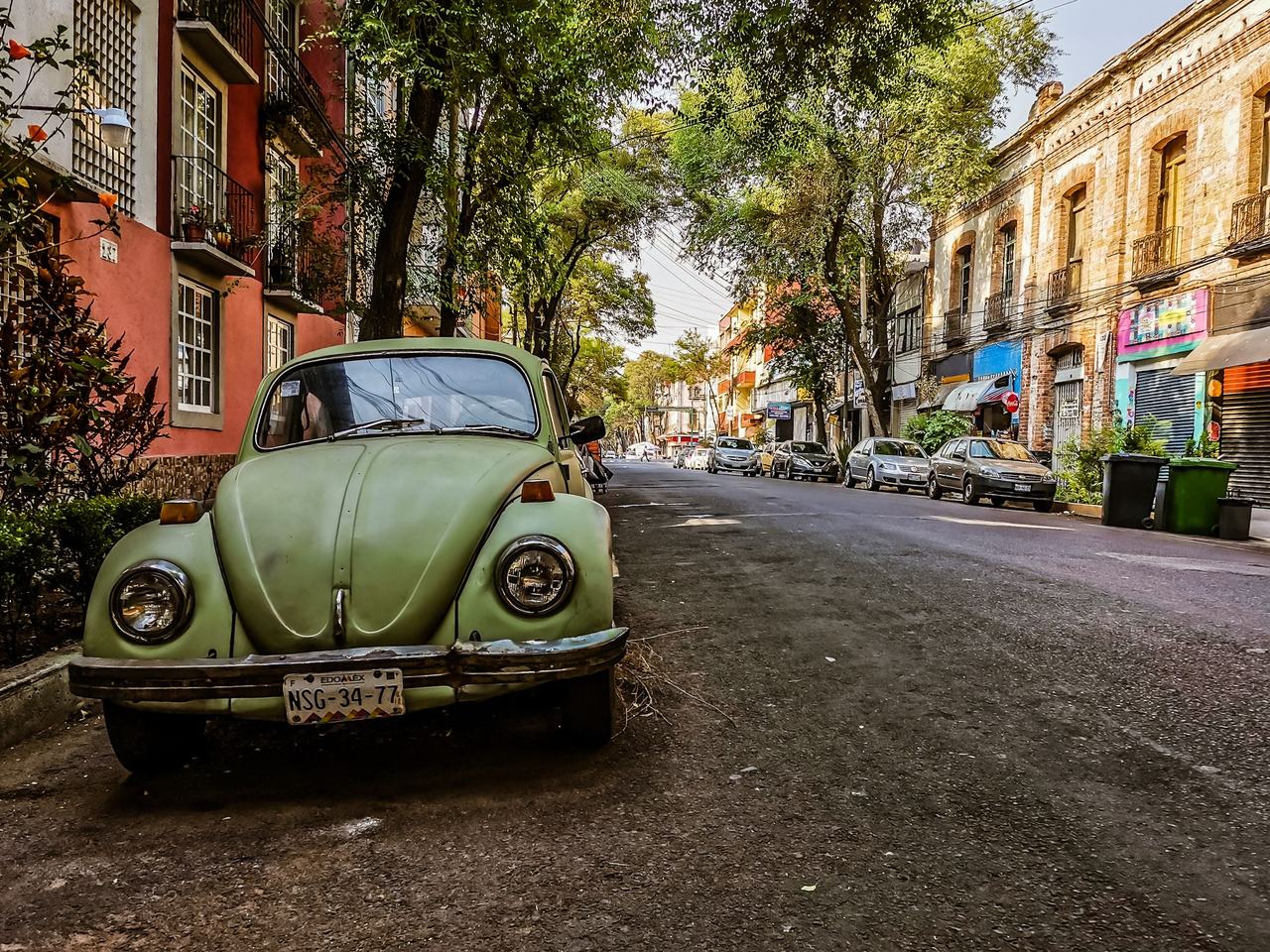
Opening photograph: A pale green Volkswagen Beetle parked on a quiet, tree-lined street in Mexico City. Photograph by Roland DRz on Pexels. Blog photo credits.