How to Ask for the Check in Mexico, at a Table or a Stand
To ask for the check in Mexico at a sit-down restaurant or taquería, say La cuenta, por favor. At a street stand, you ask ¿Cuánto le debo? instead, what do I owe you?, and the taquero adds it up out loud. Habla’s course draws exactly that line between the two. Below are both questions, the total you will hear, and how to pay in cash or by card, each with its recording from the course.
At a table: ask for the check
At a sit-down place, the request is short. The course’s note on it makes the distinction that matters most on this page: la cuenta is for a sit-down taquería, and at a stand you ask a different question.
You say
La cuenta, por favor.
The check, please.
At a sit-down taquería. At a stand you ask ¿Cuánto le debo?
Do not wait for the check to appear on its own. When you are ready to go, catch the server’s eye, or say disculpe to get their attention, and ask for la cuenta.
At a street stand: what do I owe you?
At a street stand, you ask what you owe, and the taquero tells you. In the course, Diego finishes his drink order and asks in the same line:
Diego, a friend, asks
Chica. ¿Cuánto le debo?
Small. What do I owe you?
Beto, the taquero, says
Cinco tacos y el agua. Son ciento treinta y cinco pesos.
Five tacos and the drink. That’s $135.
Beto lists what Diego had, cinco tacos y el agua, five tacos and the drink, and gives the total. The course note says this question is the usual one at the end of a taxi ride, or at a stall, so it is worth knowing well:
You ask
¿Cuánto le debo?
What do I owe you?
The usual question at the end of a taxi ride, or at a stall.
Telling them you’re done
Sometimes the check starts with a question from the other side. Beto asks if there is anything else, and the course gives you one line that answers no and asks the price together:
Beto, the taquero, asks
Aquí tiene. ¿Algo más?
Here you go. Anything else?
You ask
Es todo. ¿Cuánto es?
That’s all. How much is it?
The answer to ¿Algo más? when you are done: that’s all, and what do I owe you.
There is another route. If Beto offers you another taco and you say you have had enough, he moves straight to the bill himself. Ahorita le cobro means I’ll ring you up in a second:
Beto, the taquero, says
Sale. Ahorita le cobro.
Okay. I’ll ring you up in a second.
Either way, the next thing you hear is a number.
Following the total out loud
The total comes as a spoken number in pesos. This is the one Beto gives at the end of the meal:
Beto, the taquero, says
Son ciento treinta y cinco pesos.
That’s $135.
The course breaks it down for you: ciento is a hundred, treinta is thirty and y cinco adds five, so a hundred and thirty-five pesos. If you are not sure you caught it, say the number back as a question, the way the course teaches with prices, as in ¿Ciento sesenta pesos? for a taxi fare. A yes means you heard it right.
If numbers in Spanish are what worries you most, the guide to prices in pesos goes through the ones you will hear at counters and stands.
Cash or card
Before you count on paying by card, ask. The course notes that many small places take cash only, and in its market scene, Paty the clothes vendor answers with nada más efectivo, cash only.
You ask
¿Aceptan tarjeta?
Do you take cards?
Many small places take cash only.
Some places ask you first. At Sofía’s café, the total comes with a question about how you want to pay. Answer with one of two short lines:
Sofía, the barista, asks
Son cincuenta y cinco pesos. ¿Efectivo o tarjeta?
It’s $55. Cash or card?
You say
En efectivo.
In cash.
You say
Con tarjeta.
By card.
If you choose card, this is the reply. La terminal is the card machine:
Sofía, the barista, says
Claro. Aquí está la terminal.
Sure. Here’s the card machine.
When you hand over cash, say Aquí tiene, here you go. The course notes that you say it when you hand something over, and that staff say it to you too, as they give you your change.
You say
Aquí tiene.
Here you go.
Said when you hand something over. Staff say it to you too.
For more on paying, from asking for change to a big bill, see the guide to paying cash or card in Mexico.
Leaving after you pay
Once you have paid, the goodbye may come with a good wish. Beto sends you off with one, and the answer is igualmente, likewise:
Beto, the taquero, says
Gracias. Que le vaya bien.
Thanks. Have a good night.
The course translates Que le vaya bien here as have a good night. Answer igualmente, add gracias if you like, and you are done.
The end of a meal, start to finish
Here is how it runs at Beto’s stand. He asks if there is anything else, and you say Es todo. ¿Cuánto es?. He lists what you had and gives the total, and you say it back if you are unsure. You ask whether he takes cards, or simply pay in cash with Aquí tiene. He wishes you a good night, and you answer igualmente.
At a sit-down taquería, the only change is the first step: you ask for la cuenta when you are ready. Everything after that, the total, cash or card, the good wishes, works the same way.
Every line on this page is a recording from the app’s course. In Habla you hear each line, say it out loud and see what the app heard, so the total is easier to catch and ¿Cuánto le debo? comes out without hesitation.
Every line on this page
The 15 lines above, in order, for one last listen before you go. Each one is the recording from the Habla course.
La cuenta, por favor.The check, please.
Chica. ¿Cuánto le debo?Small. What do I owe you?
Cinco tacos y el agua. Son ciento treinta y cinco pesos.Five tacos and the drink. That’s $135.
¿Cuánto le debo?What do I owe you?
Aquí tiene. ¿Algo más?Here you go. Anything else?
Es todo. ¿Cuánto es?That’s all. How much is it?
Sale. Ahorita le cobro.Okay. I’ll ring you up in a second.
Son ciento treinta y cinco pesos.That’s $135.
¿Aceptan tarjeta?Do you take cards?
Son cincuenta y cinco pesos. ¿Efectivo o tarjeta?It’s $55. Cash or card?
En efectivo.In cash.
Con tarjeta.By card.
Claro. Aquí está la terminal.Sure. Here’s the card machine.
Aquí tiene.Here you go.
Gracias. Que le vaya bien.Thanks. Have a good night.
Common questions
How do you ask for the check in Spanish in Mexico?
At a sit-down restaurant or taquería, say La cuenta, por favor. At a street stand, ask ¿Cuánto le debo?, what do I owe you?
Do you say la cuenta at a taco stand?
At a street stand, no. The course notes that la cuenta is for a sit-down taquería, and that at a stand you ask ¿Cuánto le debo?
Will the waiter bring the check without asking in Mexico?
The course teaches you to ask for it when you are ready: La cuenta, por favor.
How do you ask if a restaurant takes cards in Mexico?
Ask ¿Aceptan tarjeta?, do you take cards? The course notes that many small places take cash only, so ask before you order.
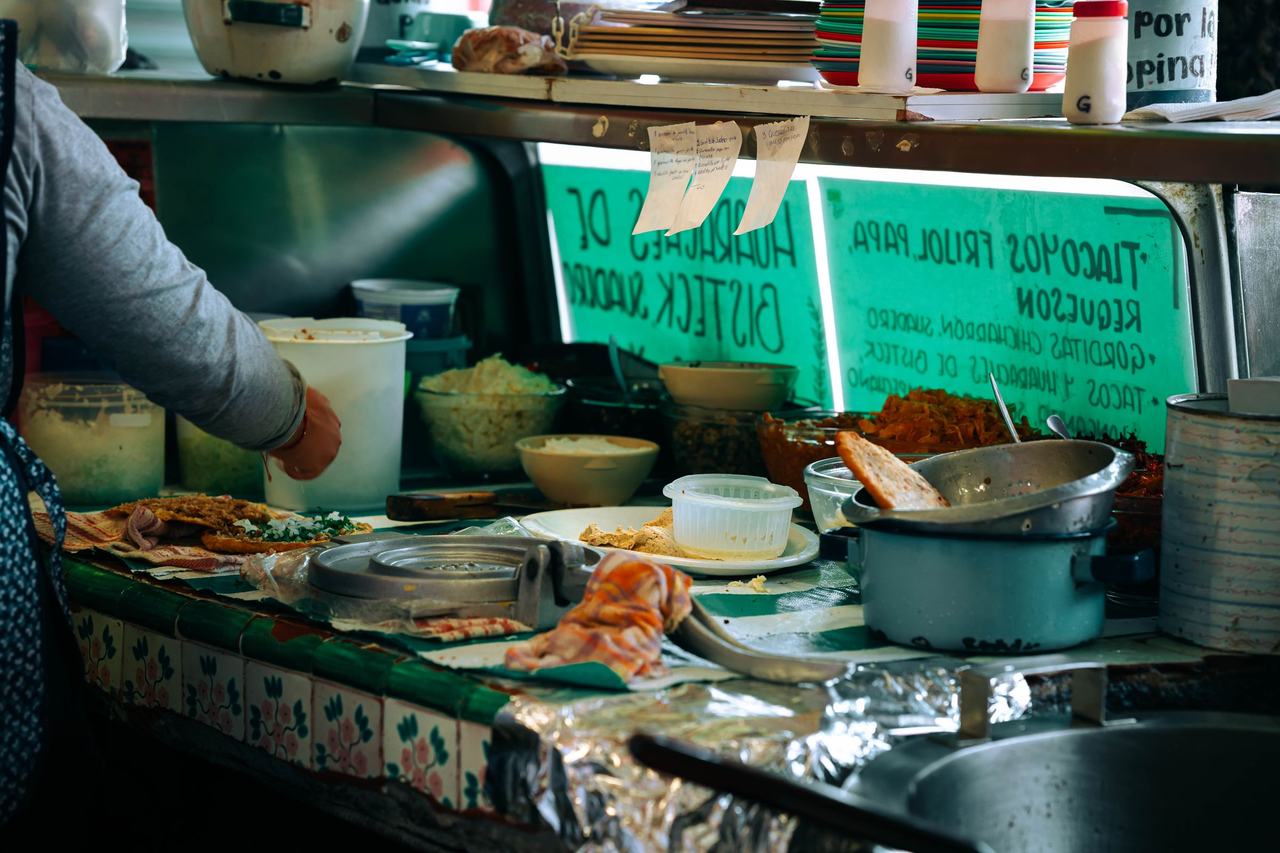
Opening photograph: A vendor reaches across a tiled street food counter crowded with pots and taco fillings in Mexico City. Photograph by Viridiana Rivera on Pexels. Blog photo credits.