How to Ask Which Subway Exit in Korean
To ask which subway exit in Korean, say 몇 번 출구예요? (myeot beon chulguyeyo, which exit is it). The answer is a number plus beon chulgu, such as 칠 번 출구예요, it’s exit 7. In the course, friends who plan to meet name the station first and then the exit, and finish with a line like 십일 번 출구 앞에서 봐요, see you in front of exit 11. Below is each step with the recordings, and the one rule about numbers that makes exit numbers easy to say.
Why the exit number matters in Seoul
Seoul subway exits are numbered, and signs on the platform show each exit number with a short description of the street or building it serves. Big stations have many exits, and the station maps near the ticket gates show which exit leads to which landmark. So “see you at Gangnam Station” is only half a plan. With an exit number, you and your friend come up the same stairs and see the same street.
That is why the exit question follows the station so quickly in the course. Minjun names the station, and the very next thing Seoyeon asks is the exit.
How to ask which exit
The key word is chulgu, exit, and myeot beon in front of it asks for the number. The course note gives the word and the rule for answering:
You ask
몇 번 출구예요?
myeot beon chulguyeyo?
Which exit is it?
출구: exit. Exit numbers are said with 일, 이, 삼: 십일 번 출구 is exit 11.
Here it is in the course scene, with the answer. Seoyeon asks, and Minjun says exit 11:
Seoyeon, a coworker, asks
몇 번 출구예요?
myeot beon chulguyeyo?
Which exit is it?
Minjun, a friend, says
십일 번 출구요.
sibil beon chulguyo.
Exit 11.
Notice the short answer: just the number and chulguyo. You do not need a full sentence to answer either. If someone asks you, the number plus beon chulgu is enough.
Saying exit numbers out loud
This is the part to get right. Korean has two sets of numbers, and the course note on the exit question says which set to use: exit numbers are said with il, i, sam. Those are the same Sino-Korean numbers the course uses for prices in won, not the native numbers used to count things.
The course gives three exits to practice on. Exit 3 is sam beon chulgu, exit 7 is chil beon chulgu, and exit 11 is sibil beon chulgu.
You say
칠 번 출구예요.
chil beon chulguyeyo.
It’s exit 7.
You say
삼 번 출구에서 만나요.
sam beon chulgueseo mannayo.
Let’s meet at exit 3.
If the two sets of numbers are new to you, native vs Sino-Korean numbers lays out both.
At the exit or in front of the exit
The course gives two ways to set the spot, and they differ by one word.
You say
삼 번 출구에서 만나요.
sam beon chulgueseo mannayo.
Let’s meet at exit 3.
You say
십일 번 출구 앞에서 봐요.
sibil beon chulgu apeseo bwayo.
See you in front of exit 11.
앞에서: in front of.
The first, sam beon chulgueseo mannayo, is let’s meet at exit 3. The second adds apeseo, which the course notes means in front of, so sibil beon chulgu apeseo bwayo is see you in front of exit 11. It also ends with bwayo, see you, instead of mannayo, let’s meet.
The full exchange: a meeting at Gangnam Station
Here is the course dialogue from start to finish. Seoyeon asks where they are meeting, Minjun names Gangnam Station, she asks which exit, he says 11, and she confirms.
Seoyeon, a coworker, asks
어디서 만나요?
eodiseo mannayo?
Where are we meeting?
Minjun, a friend, says
강남역에서 만나요.
gangnamnyeogeseo mannayo.
Let’s meet at Gangnam Station.
Seoyeon, a coworker, asks
몇 번 출구예요?
myeot beon chulguyeyo?
Which exit is it?
Minjun, a friend, says
십일 번 출구요.
sibil beon chulguyo.
Exit 11.
Seoyeon, a coworker, says
네, 그럼 십일 번 출구 앞에서 봐요.
ne, geureom sibil beon chulgu apeseo bwayo.
Okay, see you in front of exit 11, then.
Seoyeon’s opening question, eodiseo mannayo, is where are we meeting. All three of the course’s meeting lines answer it the same way, with a place and then eseo mannayo, let’s meet at: gangnamnyeogeseo mannayo for Gangnam Station, sam beon chulgueseo mannayo for exit 3. Once you hear that ending, you know a place has just been named.
The last line is the one to copy. Saying the exit back, sibil beon chulgu apeseo bwayo, confirms it for both of you, and the geureom in front of it means then, as in see you there, then.
In the course role play, you take Minjun’s side. He asks where to meet, you suggest Gangnam Station, and then he asks which exit:
Minjun, a friend, asks
어디서 만날까요?
eodiseo mannalkkayo?
Where shall we meet?
You say
강남역에서 만나요.
gangnamnyeogeseo mannayo.
Let’s meet at Gangnam Station.
Minjun, a friend, says
좋아요.
joayo.
Sounds good.
Minjun, a friend, asks
몇 번 출구 앞에서 만날까요?
myeot beon chulgu apeseo mannalkkayo?
Which exit shall we meet at?
You say
십일 번 출구 앞에서 봐요.
sibil beon chulgu apeseo bwayo.
See you in front of exit 11.
His question ends in mannalkkayo, shall we meet. The course notes, on a similar question, that this ending means shall we: it is a suggestion, and your answer settles it.
The same plan at other stations
Swap the station name and the rest stays the same. The course has one more station meeting line, for Hongik University Station, and its note adds that people often just say 홍대, Hongdae:
You say
홍대입구역에서 만나요.
hongdaeipguyeogeseo mannayo.
Let’s meet at Hongik University Station.
People often just say 홍대.
Then add the exit question, get the number, and confirm in front of that exit.
Adding a time: exits and hours use different numbers
A place is half the plan, and the other half is the time. The course closes a plan like this:
You say
좋아요. 세 시에 만나요.
joayo. se sie mannayo.
Sounds good. See you at three.
Here is the catch for numbers. The course notes that hours are counted in native Korean numbers, so three o’clock is se si. Exit 3, as you saw above, is sam beon chulgu, with the Sino-Korean number. Same three, two different words, and both can turn up in the same plan: sam beon chulgu at se si. If you keep one rule in mind, make it this one: exits and prices take il, i, sam, while hours take the counting numbers. For setting the day and time as well, see how to make plans to meet in Korean, and for the rest of the trip, from finding the station to topping up your card, see Korean phrases for the Seoul subway.
Every line on this page is a recording from Sori’s course. In the app you hear each line, say it out loud, and see what the app heard, which helps most with the numbers: sibil beon chulgu should come out as one smooth phrase before you need it.
Every line on this page
The 15 lines above, in order, for one last listen before you go. Each one is the recording from the Sori course.
몇 번 출구예요?myeot beon chulguyeyo?Which exit is it?
몇 번 출구예요?myeot beon chulguyeyo?Which exit is it?
십일 번 출구요.sibil beon chulguyo.Exit 11.
칠 번 출구예요.chil beon chulguyeyo.It’s exit 7.
삼 번 출구에서 만나요.sam beon chulgueseo mannayo.Let’s meet at exit 3.
십일 번 출구 앞에서 봐요.sibil beon chulgu apeseo bwayo.See you in front of exit 11.
어디서 만나요?eodiseo mannayo?Where are we meeting?
강남역에서 만나요.gangnamnyeogeseo mannayo.Let’s meet at Gangnam Station.
네, 그럼 십일 번 출구 앞에서 봐요.ne, geureom sibil beon chulgu apeseo bwayo.Okay, see you in front of exit 11, then.
어디서 만날까요?eodiseo mannalkkayo?Where shall we meet?
강남역에서 만나요.gangnamnyeogeseo mannayo.Let’s meet at Gangnam Station.
좋아요.joayo.Sounds good.
몇 번 출구 앞에서 만날까요?myeot beon chulgu apeseo mannalkkayo?Which exit shall we meet at?
홍대입구역에서 만나요.hongdaeipguyeogeseo mannayo.Let’s meet at Hongik University Station.
좋아요. 세 시에 만나요.joayo. se sie mannayo.Sounds good. See you at three.
Common questions
How do you say “exit” in Korean?
Chulgu. The course note on 몇 번 출구예요? gives it, and the exit question is myeot beon chulguyeyo, which exit is it.
How do you say subway exit numbers in Korean?
With the Sino-Korean numbers il, i, sam, plus beon chulgu, as the course notes. Exit 3 is sam beon chulgu, exit 7 is chil beon chulgu and exit 11 is sibil beon chulgu.
What is the difference between chulgueseo and chulgu apeseo?
Chulgueseo is at the exit, as in 삼 번 출구에서 만나요. Chulgu apeseo is in front of the exit, as in 십일 번 출구 앞에서 봐요. The course notes that apeseo means in front of.
How do I agree on a meeting point at a station in Korean?
Name the station, as in 강남역에서 만나요, then ask 몇 번 출구예요?, and confirm with the exit, as in 십일 번 출구 앞에서 봐요.
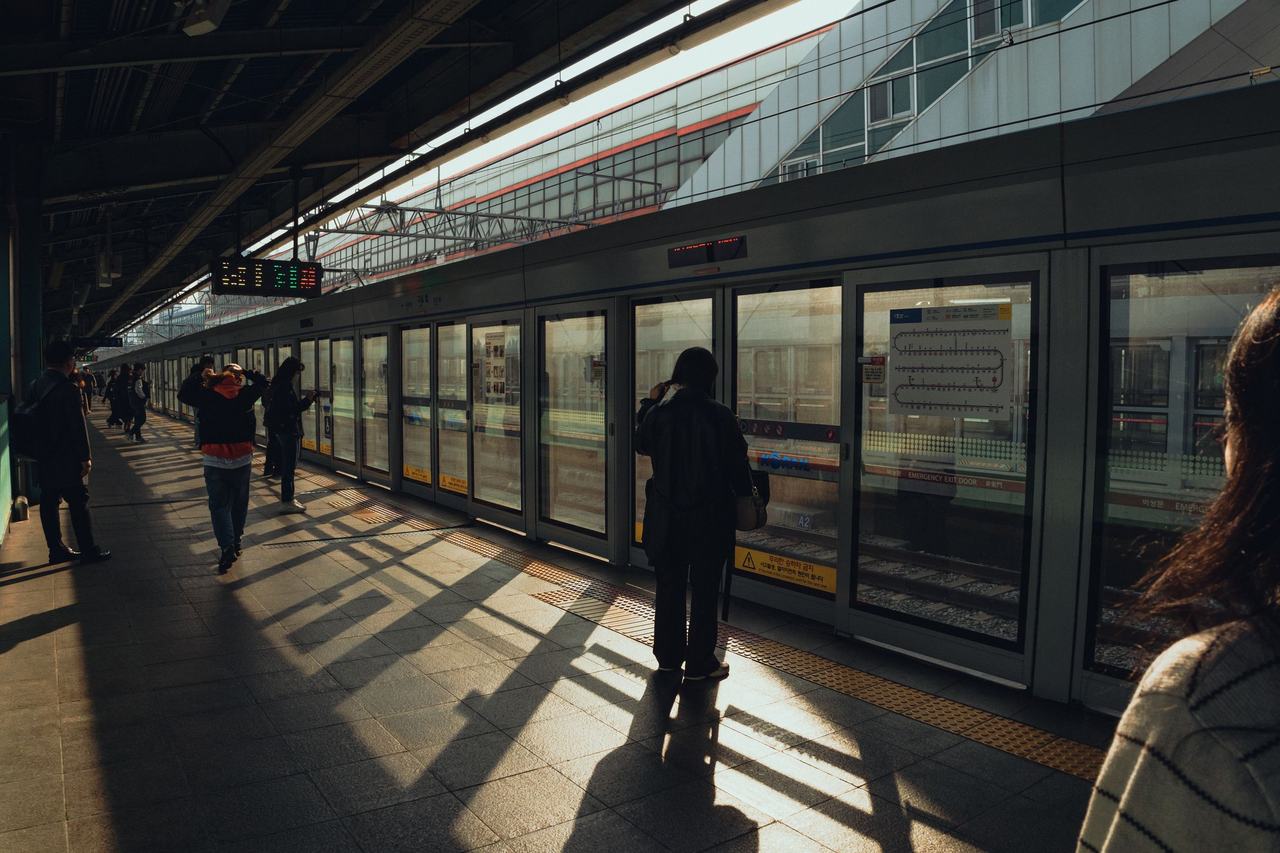
Opening photograph: Commuters wait in long afternoon shadows beside the platform screen doors of a Seoul subway station. Photograph by Theodore Nguyen on Pexels. Blog photo credits.