Korean Phrases for the Seoul Subway
The Korean you need for the Seoul subway fits in a handful of short lines. To find the station, say 지하철역 어디예요? (jihacheollyeok eodiyeyo, where’s the subway station). To top up your card at a convenience store, ask 교통카드 충전돼요?. To agree where to come up, ask 몇 번 출구예요? (myeot beon chulguyeyo, which exit is it). This page walks through the trip in order, from the street to the exit, with the replies you will hear recorded alongside your own lines.
Finding the station from the street
In the course, Tom stops Seoyeon on the street and asks for the subway station. He starts with jeogiyo, which the course notes is how you get a clerk’s or a stranger’s attention, and then asks his question.
Tom, an exchange student, asks
저기요, 지하철역 어디예요?
jeogiyo, jihacheollyeok eodiyeyo?
Excuse me, where’s the subway station?
Seoyeon, a coworker, says
저쪽으로 쭉 가세요.
jeojjogeuro jjuk gaseyo.
Go straight that way.
Her answer, jeojjogeuro jjuk gaseyo, is go straight that way. You do not need to follow every word, only the direction and the word jjuk, straight.
Your own line is just the place and the question:
You ask
지하철역 어디예요?
jihacheollyeok eodiyeyo?
Where’s the subway station?
Place + 어디예요?: where is it? 역: station.
That note is the useful part. Any place plus eodiyeyo asks where it is, and 역 means station. Jihacheol is the subway, so jihacheollyeok is the subway station. When someone has pointed you the right way, 감사합니다 (gamsahamnida) is the thank you the course calls safe for anyone.
Is it far? Understanding “five minutes on foot”
Once you know the direction, the next thing you want is distance. Tom asks the one-word question, and Seoyeon gives the answer you are hoping for:
You ask
멀어요?
meoreoyo?
Is it far?
Seoyeon, a coworker, says
아니요, 가까워요. 걸어서 오 분이에요.
aniyo, gakkawoyo. georeoseo o bunieyo.
No, it’s close. It’s five minutes on foot.
Listen for two phrases in her reply. Gakkawoyo means it’s close, and the course notes it is the opposite of meoreoyo, it’s far. Georeoseo o bunieyo is five minutes on foot. If you would rather ask the hopeful version, the course has that too:
You ask
가까워요?
gakkawoyo?
Is it close?
Seoyeon, a coworker, says
네, 가까워요. 걸어서 오 분이에요.
ne, gakkawoyo. georeoseo o bunieyo.
Yes, it’s close. It’s five minutes on foot.
Asking for a particular station
The same pattern works for any station by name. Put the name in front of eodiyeyo. The course gives Seoul Station as a full line:
You ask
서울역 어디예요?
seoullyeok eodiyeyo?
Where’s Seoul Station?
The course romanizes Seoul Station as seoullyeok, one word. The station word sits on the end of the name, the same way it does in jihacheollyeok. Once you have heard it a few times, you will start to catch yeok on the end of station names.
Topping up your transit card before the gates
If you use a T-money card, you will top it up at some point. A convenience store will do it, and the course has the whole exchange at the counter. Jimin asks, and Junho the clerk tells her it is cash only and asks how much:
Jimin, the barista, asks
그리고 교통카드 충전돼요?
geurigo gyotongkadeu chungjeondwaeyo?
And can I top up a transit card?
Junho, the store clerk, asks
네, 현금만 돼요. 얼마 충전해 드릴까요?
ne, hyeongeumman dwaeyo. eolma chungjeonhae deurilkkayo?
Sure, cash only. How much would you like to add?
The course note on this is worth remembering: convenience stores top up T-money and other transit cards for cash only, hyeongeumman dwaeyo. Your reply is the amount plus chungjeonhae juseyo, please add. Then the clerk asks you to put the card on the reader.
You say
만 원 충전해 주세요.
man won chungjeonhae juseyo.
Please add 10,000 won.
충전: charging, topping up.
Junho, the store clerk, says
네, 카드 올려 주세요.
ne, kadeu ollyeo juseyo.
Okay, put your transit card on the reader.
You do not have to talk to anyone to top up, though. T-money cards can also be reloaded at the ticket vending machines inside subway stations. The counter is handy when you are buying something anyway. For the other amounts and what the clerk says next, see how to top up a T-money card in Korean.
Exits: the number to know before you ride
Seoul subway exits are numbered, and the signs on the platform show each exit number with a short description of the street or building it serves. That is why the exit number matters as much as the station name. When someone tells you where to meet, ask which exit:
You ask
몇 번 출구예요?
myeot beon chulguyeyo?
Which exit is it?
출구: exit. Exit numbers are said with 일, 이, 삼: 십일 번 출구 is exit 11.
You say
칠 번 출구예요.
chil beon chulguyeyo.
It’s exit 7.
The course note covers the one trap: exit numbers are said with il, i, sam, the same number words used for prices, so exit 11 is sibil beon chulgu and exit 7 is chil beon chulgu. Chulgu means exit. For more on exit numbers and setting a meeting point, see how to ask which subway exit in Korean.
One more line earns its place on a full train. The course notes that jamkkanmannyo, one moment, also works as excuse me when you need someone to wait or let you past. That is the moment your stop comes up and you are not standing by the door.
You say
잠깐만요.
jamkkanmannyo.
One moment, please.
Also excuse me, when you need someone to wait or let you past.
Meeting someone and asking how long it takes
If your trip ends in a meeting, the course gives a station meeting line for Hongik University Station. Its note adds that people often just say 홍대, Hongdae, for this station.
You say
홍대입구역에서 만나요.
hongdaeipguyeogeseo mannayo.
Let’s meet at Hongik University Station.
People often just say 홍대.
To ask how long a trip will take, there is one short question. It works for any trip:
You ask
얼마나 걸려요?
eolmana geollyeoyo?
How long does it take?
The answer is a number of minutes, bun, and the course notes that minutes take Sino-Korean numbers: samsip bun is thirty minutes and sasip bun is forty. Listen for the number in front of bun and you have the answer.
All of these lines are recordings from Sori’s course. In the app you hear each one, say it out loud, and see what the app heard, which is a good way to get jihacheollyeok and myeot beon chulguyeyo out smoothly before you need them on a crowded street. For more ways to ask the way, see how to ask for directions in Korean.
Every line on this page
The 17 lines above, in order, for one last listen before you go. Each one is the recording from the Sori course.
저기요, 지하철역 어디예요?jeogiyo, jihacheollyeok eodiyeyo?Excuse me, where’s the subway station?
저쪽으로 쭉 가세요.jeojjogeuro jjuk gaseyo.Go straight that way.
지하철역 어디예요?jihacheollyeok eodiyeyo?Where’s the subway station?
멀어요?meoreoyo?Is it far?
아니요, 가까워요. 걸어서 오 분이에요.aniyo, gakkawoyo. georeoseo o bunieyo.No, it’s close. It’s five minutes on foot.
가까워요?gakkawoyo?Is it close?
네, 가까워요. 걸어서 오 분이에요.ne, gakkawoyo. georeoseo o bunieyo.Yes, it’s close. It’s five minutes on foot.
서울역 어디예요?seoullyeok eodiyeyo?Where’s Seoul Station?
그리고 교통카드 충전돼요?geurigo gyotongkadeu chungjeondwaeyo?And can I top up a transit card?
네, 현금만 돼요. 얼마 충전해 드릴까요?ne, hyeongeumman dwaeyo. eolma chungjeonhae deurilkkayo?Sure, cash only. How much would you like to add?
만 원 충전해 주세요.man won chungjeonhae juseyo.Please add 10,000 won.
네, 카드 올려 주세요.ne, kadeu ollyeo juseyo.Okay, put your transit card on the reader.
몇 번 출구예요?myeot beon chulguyeyo?Which exit is it?
칠 번 출구예요.chil beon chulguyeyo.It’s exit 7.
잠깐만요.jamkkanmannyo.One moment, please.
홍대입구역에서 만나요.hongdaeipguyeogeseo mannayo.Let’s meet at Hongik University Station.
얼마나 걸려요?eolmana geollyeoyo?How long does it take?
Common questions
How do you say “subway station” in Korean?
Jihacheollyeok. To ask where it is, say 지하철역 어디예요?. The course notes that 역 means station, so it also ends station names, as in seoullyeok, Seoul Station.
How do I ask which exit to use in Korean?
Ask 몇 번 출구예요? (myeot beon chulguyeyo). The answer is a number plus beon chulgu, and the course notes that exit numbers are said with il, i, sam: exit 7 is chil beon chulgu.
Can I top up a T-money card at a convenience store?
Yes. Ask 교통카드 충전돼요? and then say the amount, such as 만 원 충전해 주세요. The course notes that convenience stores do it for cash only. The ticket vending machines inside subway stations also reload T-money cards.
How do you say “how long does it take” in Korean?
Say 얼마나 걸려요? (eolmana geollyeoyo). The reply is a number of minutes with bun, said in Sino-Korean numbers, such as samsip bun, thirty minutes.
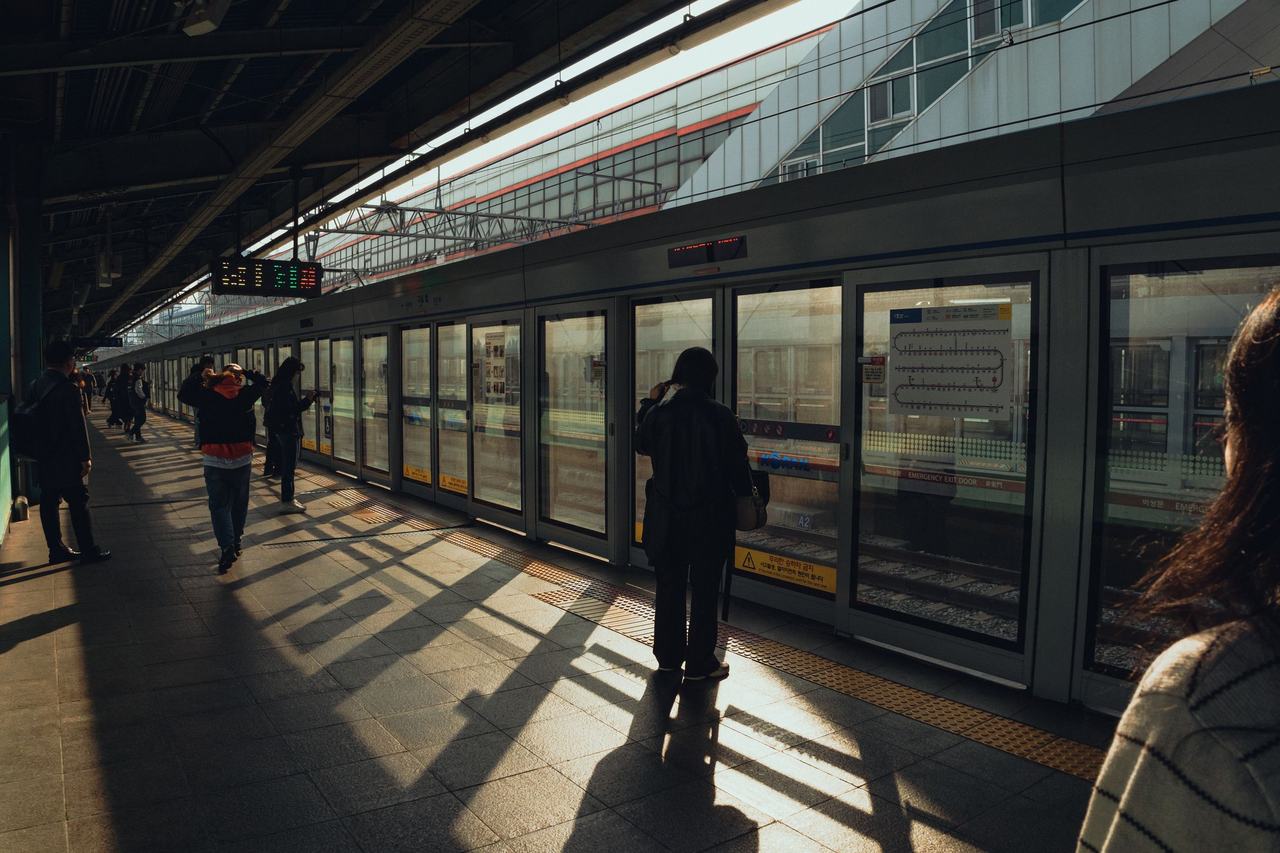
Opening photograph: Commuters wait in long afternoon shadows beside the platform screen doors of a Seoul subway station. Photograph by Theodore Nguyen on Pexels. Blog photo credits.