How to Ask for Directions in Korean on the Street
To ask for directions in Korean, get someone’s attention with 저기요 (jeogiyo, excuse me), then say the place plus eodiyeyo, where is it: 지하철역 어디예요? (jihacheollyeok eodiyeyo, where’s the subway station). The answers you get back are short. The three the course teaches are go straight that way, it’s on the right, and it’s five minutes on foot. Below are the questions for four places and every answer recorded, so you can recognize them when someone says them at normal speed.
Stopping someone politely
Start with one word. The course notes that jeogiyo is how you get a clerk’s or a stranger’s attention, and it works the same on the street as in a shop.
You say
저기요.
jeogiyo.
Excuse me.
To get a clerk’s or a stranger’s attention.
Sometimes you will not need it. In the course role play, Seoyeon offers help before you ask:
Seoyeon, a coworker, asks
어디 찾으세요?
eodi chajeuseyo?
Where are you trying to get to?
Eodi chajeuseyo is where are you trying to get to. Answer with the place name, or with the full question below. For more on jeogiyo and the similar yeogiyo, see yeogiyo vs jeogiyo.
One pattern for any place: “Where is the …?”
The course note on the subway question gives the pattern for any place: a place, then eodiyeyo.
You ask
지하철역 어디예요?
jihacheollyeok eodiyeyo?
Where’s the subway station?
Place + 어디예요?: where is it? 역: station.
Swap in the place you need. Besides the subway station, the course has the bathroom and the bus stop.
You ask
화장실 어디예요?
hwajangsil eodiyeyo?
Where’s the bathroom?
You ask
버스 정류장 어디예요?
beoseu jeongnyujang eodiyeyo?
Where’s the bus stop?
Hwajangsil is the bathroom and beoseu jeongnyujang is the bus stop. The question stays the same every time, so once you can say one, you can say them all.
Inside a shop, the course uses a slightly different question. Its note says eodi isseoyo is for things in a shop or a room, such as the milk at a convenience store:
You ask
우유 어디 있어요?
uyu eodi isseoyo?
Where’s the milk?
어디 있어요?: where is it? For things in a shop or a room.
So eodiyeyo is for places you walk to, and eodi isseoyo is for things on a shelf.
When you do not know if there is one nearby
Sometimes the question is not where the pharmacy is, but whether there is one at all. For that, the course asks with geuncheoe, nearby, and isseoyo, is there:
You ask
근처에 약국 있어요?
geuncheoe yakguk isseoyo?
Is there a pharmacy nearby?
약국: pharmacy, marked with a big 약 on the sign.
The note adds a practical detail: a pharmacy, yakguk, is marked with a big 약 on its sign, so once someone points you down a street, that one character is what to look for. For what to say once you are inside, see Korean pharmacy phrases for travelers.
Understanding the answer
The answers are the harder half, because they come at normal speed. The good news is that the course’s answers are short, and each has one key word.
Seoyeon, a coworker, says
저쪽으로 쭉 가세요.
jeojjogeuro jjuk gaseyo.
Go straight that way.
Jeojjogeuro jjuk gaseyo is go straight that way. Jeojjogeuro is that way, toward over there, and jjuk is straight on.
Seoyeon, a coworker, says
오른쪽에 있어요.
oreunjjoge isseoyo.
It’s on the right.
Oreunjjoge isseoyo is it’s on the right. The isseoyo at the end is the same word as in the pharmacy question: it is there.
If you only catch one word of an answer, let it be one of these three: jjuk, oreunjjoge or a number followed by bun, minutes.
Is it far or close?
Before you set off, you may want to know the distance. There are two questions, one for each hope:
You ask
멀어요?
meoreoyo?
Is it far?
You ask
가까워요?
gakkawoyo?
Is it close?
In the course, the answer comes with a time. Seoyeon answers no to is it far, and adds how long it takes on foot:
Seoyeon, a coworker, says
아니요, 걸어서 오 분이에요.
aniyo, georeoseo o bunieyo.
No, it’s five minutes on foot.
Georeoseo o bunieyo is it’s five minutes on foot. Georeoseo is on foot, and o bun is five minutes. The course note on gakkawoyo adds that it is the opposite of meoreoyo: one is close, the other is far.
You say
가까워요.
gakkawoyo.
It’s close.
The opposite of 멀어요, it’s far.
The whole exchange, start to finish
Here is the course dialogue in one piece. Tom stops Seoyeon, asks for the station, asks if it is far, and gets everything he needs in two short answers:
Tom, an exchange student, asks
저기요, 지하철역 어디예요?
jeogiyo, jihacheollyeok eodiyeyo?
Excuse me, where’s the subway station?
Seoyeon, a coworker, says
저쪽으로 쭉 가세요.
jeojjogeuro jjuk gaseyo.
Go straight that way.
Tom, an exchange student, asks
멀어요?
meoreoyo?
Is it far?
Seoyeon, a coworker, says
아니요, 가까워요. 걸어서 오 분이에요.
aniyo, gakkawoyo. georeoseo o bunieyo.
No, it’s close. It’s five minutes on foot.
Notice how little Tom says: jeogiyo, the place, eodiyeyo, and then one word, meoreoyo. Seoyeon does the rest. That is the whole shape of asking the way in the course, and it is a good one to copy, because the less you say, the less there is to go wrong. Your job is mostly to listen for three things: a direction, a side, and a time.
The same shape works for any named place. Swap the station for Seoul Station, 서울역 어디예요?, or for the bus stop or the bathroom, and the rest of the conversation runs the same way. Here it is as a checklist:
- Get attention with jeogiyo.
- Say the place plus eodiyeyo.
- Listen for jjuk, straight, or oreunjjoge, on the right.
- Ask meoreoyo or gakkawoyo if you want the distance.
- Say thank you.
Thanking them and moving on
When you have your answer, thank them with gamsahamnida, the polite thank you the course gives for anyone. In the course role play, Seoyeon sends you off with a kind line of her own:
You say
감사합니다.
gamsahamnida.
Thank you.
Seoyeon, a coworker, says
조심히 가세요.
josimhi gaseyo.
Take care.
Josimhi gaseyo is take care. Hearing it means the conversation is over and you are on your way.
Every line on this page is a recording from Sori’s course. In the app you hear each line, say it out loud, and see what the app heard. For directions, the listening side matters as much as the speaking side: play the answers on this page a few times until jjuk gaseyo and oreunjjoge isseoyo make sense before the speaker finishes.
Every line on this page
The 18 lines above, in order, for one last listen before you go. Each one is the recording from the Sori course.
저기요.jeogiyo.Excuse me.
어디 찾으세요?eodi chajeuseyo?Where are you trying to get to?
지하철역 어디예요?jihacheollyeok eodiyeyo?Where’s the subway station?
화장실 어디예요?hwajangsil eodiyeyo?Where’s the bathroom?
버스 정류장 어디예요?beoseu jeongnyujang eodiyeyo?Where’s the bus stop?
우유 어디 있어요?uyu eodi isseoyo?Where’s the milk?
근처에 약국 있어요?geuncheoe yakguk isseoyo?Is there a pharmacy nearby?
저쪽으로 쭉 가세요.jeojjogeuro jjuk gaseyo.Go straight that way.
오른쪽에 있어요.oreunjjoge isseoyo.It’s on the right.
멀어요?meoreoyo?Is it far?
가까워요?gakkawoyo?Is it close?
아니요, 걸어서 오 분이에요.aniyo, georeoseo o bunieyo.No, it’s five minutes on foot.
가까워요.gakkawoyo.It’s close.
저기요, 지하철역 어디예요?jeogiyo, jihacheollyeok eodiyeyo?Excuse me, where’s the subway station?
멀어요?meoreoyo?Is it far?
아니요, 가까워요. 걸어서 오 분이에요.aniyo, gakkawoyo. georeoseo o bunieyo.No, it’s close. It’s five minutes on foot.
감사합니다.gamsahamnida.Thank you.
조심히 가세요.josimhi gaseyo.Take care.
Common questions
How do you say “where is” in Korean?
For a place, put the place in front of eodiyeyo, as in 화장실 어디예요?. For things in a shop or a room, the course uses eodi isseoyo, as in 우유 어디 있어요?.
How do you say “excuse me” to a stranger in Korean?
저기요 (jeogiyo). The course notes it is how you get a clerk’s or a stranger’s attention.
What does jjuk gaseyo mean?
Go straight. In the course it comes as jeojjogeuro jjuk gaseyo, go straight that way.
How do you ask “is it far” in Korean?
Say 멀어요? (meoreoyo), or ask the hopeful version, 가까워요? (gakkawoyo). A typical answer gives the time on foot, such as georeoseo o bunieyo, five minutes on foot.
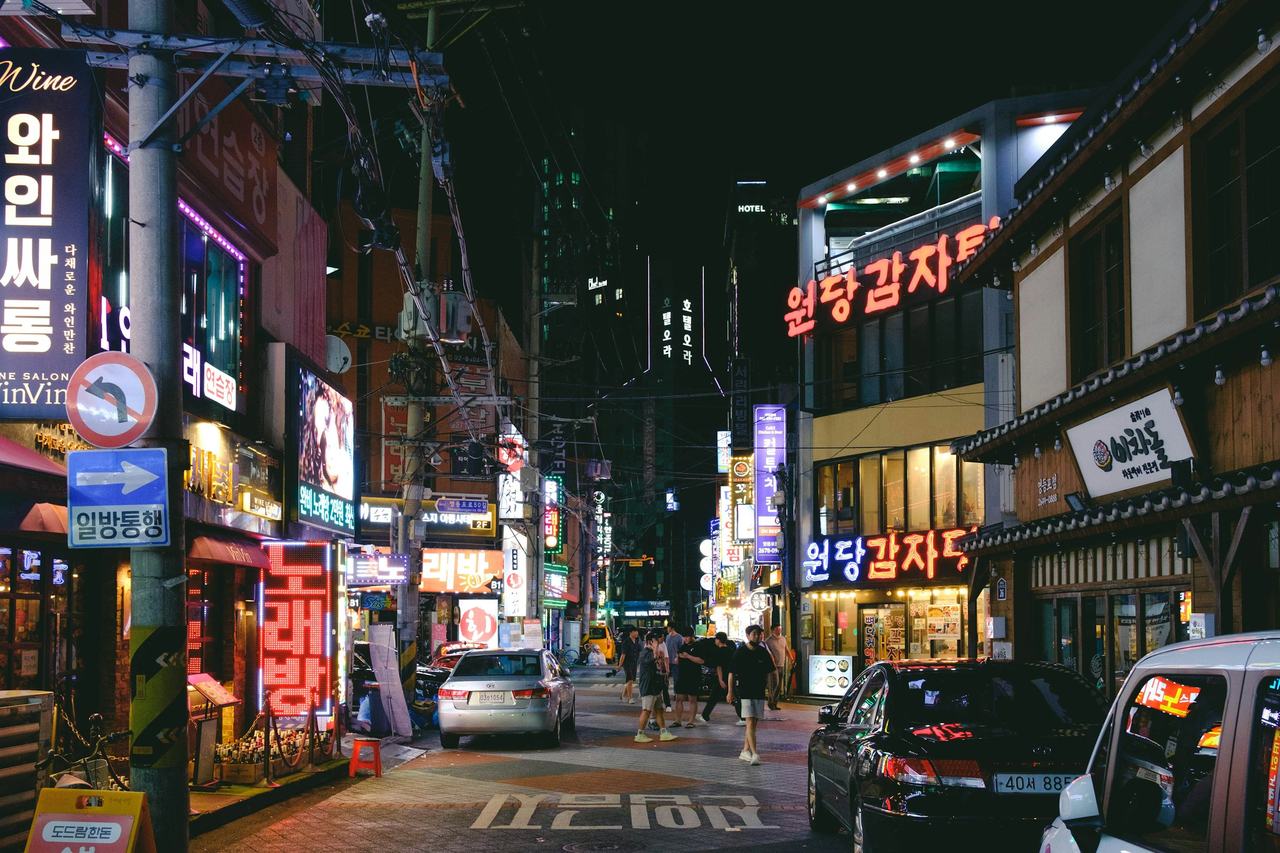
Opening photograph: A silver taxi drives past shops and pedestrians on a busy Seoul street. Photograph by Rüveyda Akkaya on Pexels. Blog photo credits.