How to Take a Taxi in Seoul in Korean
To take a taxi in Seoul in Korean, say the place and euro ga juseyo, please take me to: 명동으로 가 주세요 (myeongdongeuro ga juseyo, to Myeongdong, please). When you are nearly there, say 여기서 세워 주세요 (yeogiseo sewo juseyo, please stop here), and to pay, 카드로 할게요 (I’ll pay by card). With those three lines, you can get through a whole ride. Below is the whole trip in order, with the recordings of Park, the course’s taxi driver, so you know what you will hear at each step.
Getting in: “Where to?” and your destination
In the course, the driver’s first line is where to. Park asks it as Seoyeon gets in:
The taxi driver asks
어디로 가세요?
eodiro gaseyo?
Where to?
You say
명동으로 가 주세요.
myeongdongeuro ga juseyo.
To Myeongdong, please.
Place + 으로 가 주세요 (로 after a vowel or ㄹ): please take me to that place.
The course note gives the pattern: a place, then euro ga juseyo, or ro ga juseyo after a vowel or ㄹ. That small change is the only thing that moves. Here are two more destinations from the course, one with each ending:
You say
서울역으로 가 주세요.
seoullyeogeuro ga juseyo.
To Seoul Station, please.
You say
홍대로 가 주세요.
hongdaero ga juseyo.
To Hongdae, please.
Seoullyeogeuro takes the longer ending and hongdaero the shorter one. For anywhere else, the name goes in the same slot, with whichever ending fits. For how the names themselves sound, see how to say Seoul place names in Korean.
Park answers 네, 알겠습니다, ne, algetseumnida, sure. That is your sign he has understood and you can sit back.
During the ride: the seat belt, the time and the traffic
In the course role play, the driver’s next line is a request:
The taxi driver says
안전벨트 해 주세요.
anjeonbelteu hae juseyo.
Please put your seat belt on.
Anjeonbelteu hae juseyo is please put your seat belt on. A ne and the click of the buckle is the whole answer.
If you want to know how long the ride will take, ask the short question. Seoyeon asks it, and Park’s reply explains why it will be slow:
You ask
얼마나 걸려요?
eolmana geollyeoyo?
How long does it take?
The taxi driver says
지금 길이 막혀서 삼십 분쯤 걸려요.
jigeum giri makyeoseo samsip bunjjeum geollyeoyo.
The traffic’s bad right now, so about thirty minutes.
The course breaks his answer down. Giri makyeoseo means the traffic is bad, literally the road is blocked, so it will take samsip bunjjeum, about thirty minutes. Minutes come in Sino-Korean numbers, so listen for samsip, sasip and their neighbors in front of bun.
You can also ask about the traffic directly, and the course note gives the literal meaning:
You ask
길이 많이 막혀요?
giri mani makyeoyo?
Is the traffic bad?
Literally: is the road very blocked?
Telling the driver where to stop
In the course, as the ride ends, Park says you are nearly there and asks where to stop:
The taxi driver asks
다 와 가요. 어디서 세워 드릴까요?
da wa gayo. eodiseo sewo deurilkkayo?
We’re nearly there. Where shall I stop?
Da wa gayo is we’re nearly there, and eodiseo sewo deurilkkayo is where shall I stop. You have three good answers. The simplest is here:
You say
여기서 세워 주세요.
yeogiseo sewo juseyo.
Please stop here.
세우다: to stop a car.
If here is a little too soon, ask for just up ahead:
You say
저 앞에서 세워 주세요.
jeo apeseo sewo juseyo.
Please stop just up ahead.
Or name a landmark you can see. Minjun picks the convenience store:
Minjun, a friend, says
저 편의점 앞에서 세워 주세요.
jeo pyeonuijeom apeseo sewo juseyo.
Please stop in front of that convenience store.
The course has the bank too, 은행 앞에서 세워 주세요, please stop in front of the bank. The pattern is the place plus apeseo sewo juseyo: please stop in front of it. When the car slows, the driver may check with one word, yeogiyo, here, and a yes settles it:
The taxi driver asks
여기요?
yeogiyo?
Here?
Minjun, a friend, says
네, 여기서 세워 주세요.
ne, yeogiseo sewo juseyo.
Yes, stop here, please.
If the car has stopped in traffic and you are happy to walk the last bit, this line tells the driver you will get out:
You say
여기서 내릴게요.
yeogiseo naerilgeyo.
I’ll get out here.
내리다: to get off or out.
The two kinds of line do different jobs, and the course notes show why. Sewo juseyo comes from 세우다, to stop a car, so it asks the driver to pull over. Naerilgeyo comes from 내리다, to get off or out, so it tells the driver what you are about to do. One asks for a stop, the other announces that you are getting out.
Paying the fare
When you stop, the driver tells you the fare, or you can ask. Seoyeon asks with gisanim, the course’s word for the driver, then eolmayeyo, how much is it:
Seoyeon, a coworker, asks
기사님, 얼마예요?
gisanim, eolmayeyo?
Excuse me, how much is it?
The taxi driver says
네, 만 사천 원 나왔습니다.
ne, man sacheon won nawatseumnida.
Okay. That’s 14,000 won.
On Minjun’s ride, Park says the fare without being asked: man sacheon won, 14,000 won. For more on how prices sound, see how to say prices in Korean won.
If the driver speaks first, you may hear 다 왔어요, da wasseoyo, here we are, before the fare. Then say how you will pay. T-money works on subways, city buses and taxis, so the transit card in your pocket can pay for the ride too. In the course, Seoyeon pays by card and Park tells her where to tap it:
You say
카드로 할게요.
kadeuro halgeyo.
I’ll pay by card.
The taxi driver says
네, 여기 대 주세요.
ne, yeogi dae juseyo.
Sure, tap it here.
Yeogi dae juseyo is tap it here. Then the goodbye. Park says it to you as the one leaving:
The taxi driver says
네, 안녕히 가세요.
ne, annyeonghi gaseyo.
Bye, take care.
A 감사합니다 (gamsahamnida) as you open the door is all that is left. If you would rather pay in cash, the course line is 현금으로 할게요, hyeongeumeuro halgeyo.
The whole ride in order
- The driver asks where to. You say the place plus euro ga juseyo or ro ga juseyo.
- The driver asks you to put your seat belt on. You say ne.
- If you want, ask how long it takes, or whether the traffic is bad.
- Near the end, the driver asks where to stop. Say here, just up ahead, or in front of a landmark.
- The driver says the fare, or you ask gisanim, eolmayeyo.
- Say you will pay by card, tap where the driver points, and say thank you.
Every line on this page is a recording from Sori’s course. In the app you hear each line, say it out loud, and see what the app heard, which is a good way to make yeogiseo sewo juseyo come out at the right moment and not a block too late.
Every line on this page
The 20 lines above, in order, for one last listen before you go. Each one is the recording from the Sori course.
어디로 가세요?eodiro gaseyo?Where to?
명동으로 가 주세요.myeongdongeuro ga juseyo.To Myeongdong, please.
서울역으로 가 주세요.seoullyeogeuro ga juseyo.To Seoul Station, please.
홍대로 가 주세요.hongdaero ga juseyo.To Hongdae, please.
안전벨트 해 주세요.anjeonbelteu hae juseyo.Please put your seat belt on.
얼마나 걸려요?eolmana geollyeoyo?How long does it take?
지금 길이 막혀서 삼십 분쯤 걸려요.jigeum giri makyeoseo samsip bunjjeum geollyeoyo.The traffic’s bad right now, so about thirty minutes.
길이 많이 막혀요?giri mani makyeoyo?Is the traffic bad?
다 와 가요. 어디서 세워 드릴까요?da wa gayo. eodiseo sewo deurilkkayo?We’re nearly there. Where shall I stop?
여기서 세워 주세요.yeogiseo sewo juseyo.Please stop here.
저 앞에서 세워 주세요.jeo apeseo sewo juseyo.Please stop just up ahead.
저 편의점 앞에서 세워 주세요.jeo pyeonuijeom apeseo sewo juseyo.Please stop in front of that convenience store.
여기요?yeogiyo?Here?
네, 여기서 세워 주세요.ne, yeogiseo sewo juseyo.Yes, stop here, please.
여기서 내릴게요.yeogiseo naerilgeyo.I’ll get out here.
기사님, 얼마예요?gisanim, eolmayeyo?Excuse me, how much is it?
네, 만 사천 원 나왔습니다.ne, man sacheon won nawatseumnida.Okay. That’s 14,000 won.
카드로 할게요.kadeuro halgeyo.I’ll pay by card.
네, 여기 대 주세요.ne, yeogi dae juseyo.Sure, tap it here.
네, 안녕히 가세요.ne, annyeonghi gaseyo.Bye, take care.
Common questions
How do I tell a Seoul taxi driver where to go in Korean?
Say the place plus euro ga juseyo, or ro ga juseyo after a vowel, as in 명동으로 가 주세요 or 홍대로 가 주세요. In the course, the driver answers ne, algetseumnida, sure.
How do you say “stop here” in Korean?
여기서 세워 주세요 (yeogiseo sewo juseyo). For just up ahead, say 저 앞에서 세워 주세요. The course notes that sewo comes from the verb for stopping a car.
Can I pay for a taxi in Seoul by card?
In the course, the passenger says 카드로 할게요 and the driver says yeogi dae juseyo, tap it here. T-money also works on taxis, as well as subways and city buses.
What does eodiro gaseyo mean?
It is where to, the driver’s first question. Answer with your destination plus euro ga juseyo or ro ga juseyo.
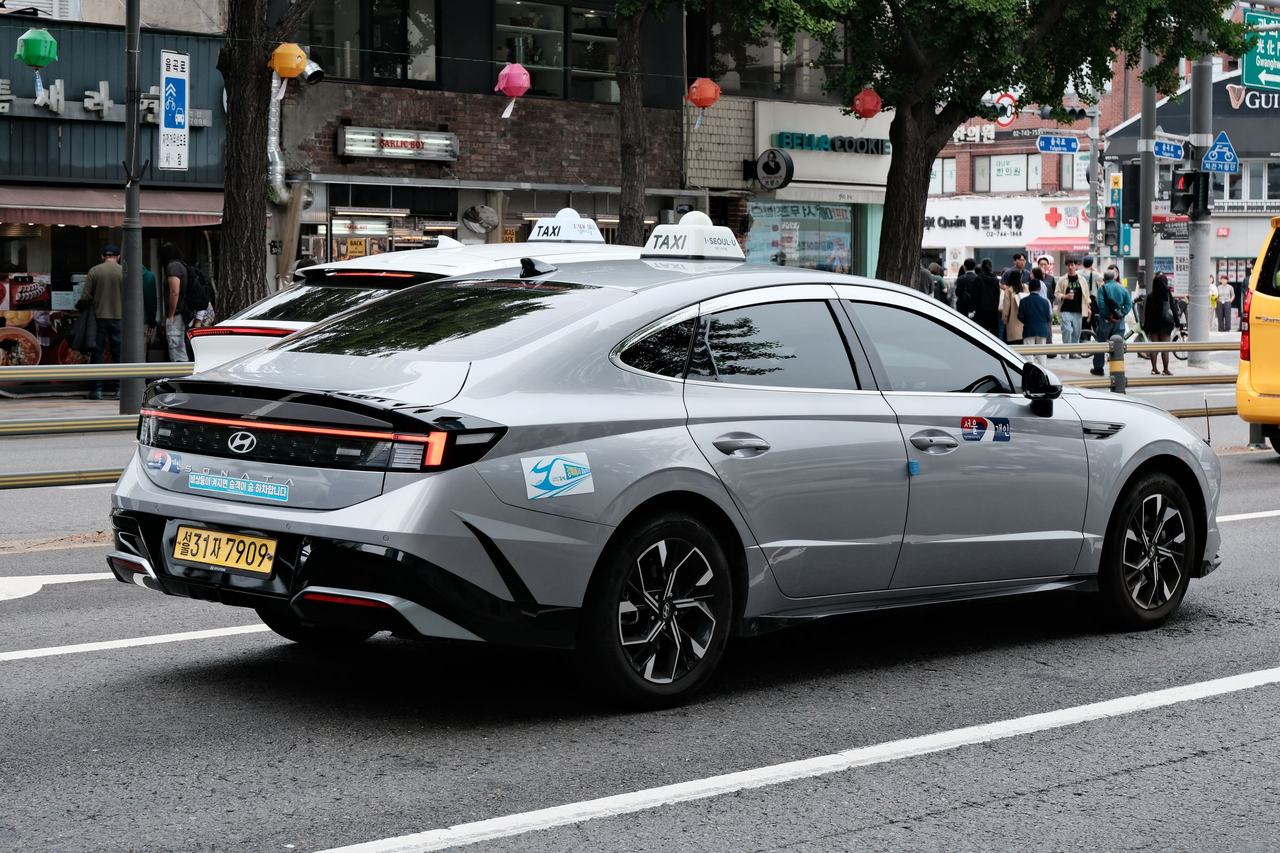
Opening photograph: A silver taxi drives past shops and pedestrians on a busy Seoul street. Photograph by Rüveyda Akkaya on Pexels. Blog photo credits.