How to Say Goodbye in Korean: Leaving vs Staying
To say goodbye in Korean, first ask who is walking away. If you are the one leaving, say 안녕히 계세요 (annyeonghi gyeseyo), which the course reads literally as “stay in peace.” If the other person is leaving and you are staying, say 안녕히 가세요 (annyeonghi gaseyo), “go in peace.” On a trip you are nearly always the one walking out of a café, a store or a taxi, so you will mostly say annyeonghi gyeseyo and hear annyeonghi gaseyo in return.
The rule: who walks away
The two goodbyes sound almost the same. Both begin with annyeonghi, and only the last word changes. The course notes give the literal sense of each one, and that sense is the easiest way to keep them apart:
You say
안녕히 계세요.
annyeonghi gyeseyo.
Goodbye. (You are leaving.)
Said by the one who leaves to the one who stays: stay in peace.
You say
안녕히 가세요.
annyeonghi gaseyo.
Goodbye. (They are leaving.)
Said to the one who leaves: go in peace.
So the person who leaves tells the person who stays to stay in peace, and the person who stays tells the person who leaves to go in peace. You are always wishing the other person well in what they are about to do, not describing yourself.
There is a second hook in the course itself. The same gaseyo turns up when someone gives you directions on the street: jeojjogeuro jjuk gaseyo, go straight that way. If you remember that gaseyo travels with going, you will hand it to the person who goes.
Leaving a café or a store: you say gyeseyo
The course’s very first lesson shows the rule at a café counter. Seoyeon, a coworker, picks up her order from Jimin, the barista, thanks her and heads for the door:
Jimin, the barista, says
여기요.
yeogiyo.
Here you go.
Seoyeon, a coworker, says
감사합니다. 안녕히 계세요.
gamsahamnida. annyeonghi gyeseyo.
Thank you. Goodbye.
As the course explains it, Seoyeon says annyeonghi gyeseyo because she is the one leaving, and Jimin, who stays behind the counter, answers with annyeonghi gaseyo. Notice the order: thanks first, then the goodbye. 감사합니다, then 안녕히 계세요, is a complete and polite way to leave any counter.
The convenience store lesson works the same way. Annyeonghi gyeseyo is one of the phrases you practice there, and Junho, the clerk, sends you off with the other one. Here is the exchange as it happens at the register:
Junho, the store clerk, says
네, 감사합니다. 안녕히 가세요.
ne, gamsahamnida. annyeonghi gaseyo.
Okay, thank you. Goodbye.
You say
안녕히 계세요.
annyeonghi gyeseyo.
Goodbye. (You are leaving.)
If you only learn one goodbye before your trip, learn this one. Shops, cafés, restaurants and pharmacies are all places you leave and someone else stays.
The goodbyes Seoul staff say to you
Once you know the rule, you will start to notice annyeonghi gaseyo at the end of a purchase or a ride. In the course you hear it from three different people who serve you, and the recordings are worth hearing side by side, because the words are the same while the setting changes.
The taxi driver says it on its own as you get out:
The taxi driver says
안녕히 가세요.
annyeonghi gaseyo.
Goodbye.
In another ride, he adds ne in front after you tap your card. The course note on ne says it also means okay or sure, so here it works like “all right, then”:
The taxi driver says
네, 안녕히 가세요.
ne, annyeonghi gaseyo.
Bye, take care.
The pharmacist, Kim, says the same thing once he has told you how to take your medicine:
The pharmacist says
네, 안녕히 가세요.
ne, annyeonghi gaseyo.
Okay, take care.
The course translates these as “Goodbye,” “Bye, take care” and “Okay, take care.” That is a useful lesson in itself: annyeonghi gaseyo covers all three, and you do not need to work out which English version a person meant.
What do you say? In the course’s taxi scene, you thank the driver with a simple 감사합니다 as you tap your card, and his goodbye comes after it. At the pharmacy, the course has you say this just before his goodbye: it confirms you understood the instructions and thanks him in one go.
You say
네, 알겠습니다. 감사합니다.
ne, algetseumnida. gamsahamnida.
All right, thank you.
Softer send-offs: take care and come again
Not every goodbye uses annyeonghi. The course has a few other ways people see you off, and they are good to recognize so they do not catch you by surprise.
When someone has given you directions, they may close with this. It ends in the same gaseyo as the standard goodbye, again said to the person who is going, and in the course you answer it with a thank you:
Seoyeon, a coworker, says
조심히 가세요.
josimhi gaseyo.
Take care.
At a restaurant, the owner, Choi, sends you off with thanks and an invitation back. The course has you answer with a different line for the moment you leave, and its note says it is said as you leave a restaurant, or to whoever paid:
The restaurant owner says
감사합니다. 또 오세요.
gamsahamnida. tto oseyo.
Thank you. Come again.
You say
잘 먹었습니다.
jal meogeotseumnida.
Thank you for the meal.
A set phrase: said as you leave a restaurant, or to whoever paid.
The grandmother at the market sock stall says the same kind of thing in a warmer, more casual way. She uses gomawoyo, the friendly thanks the course teaches for friends and coworkers:
The market seller says
고마워요. 또 와요.
gomawoyo. tto wayo.
Thanks. Come again.
Goodbyes between friends
In the course’s scenes between friends, nobody parts with a set phrase. People name the next time instead: let’s meet again, I’ll be in touch, see you tomorrow. Here are three lines from the end of a language exchange meetup and from making plans:
Jimin, the barista, says
다음에 또 만나요.
daeume tto mannayo.
Let’s meet again.
You say
나중에 연락할게요.
najunge yeollakalgeyo.
I’ll be in touch.
연락: getting in touch. Said as you part.
You say
네, 내일 봐요.
ne, naeil bwayo.
Okay, see you tomorrow.
On the phone, a call between friends in the course ends with an agreement to talk later:
Minjun, a friend, says
네, 이따 통화해요.
ne, itta tonghwahaeyo.
Okay, talk later.
Every line on this page is a real recording from Sori’s course, so you can hear how these goodbyes sound at real speed. The app has you hear each line, say it out loud and then shows you what it heard, which is a good way to make gyeseyo come out by reflex when you reach the door.
Every line on this page
The 17 lines above, in order, for one last listen before you go. Each one is the recording from the Sori course.
안녕히 계세요.annyeonghi gyeseyo.Goodbye. (You are leaving.)
안녕히 가세요.annyeonghi gaseyo.Goodbye. (They are leaving.)
여기요.yeogiyo.Here you go.
감사합니다. 안녕히 계세요.gamsahamnida. annyeonghi gyeseyo.Thank you. Goodbye.
네, 감사합니다. 안녕히 가세요.ne, gamsahamnida. annyeonghi gaseyo.Okay, thank you. Goodbye.
안녕히 가세요.annyeonghi gaseyo.Goodbye.
네, 안녕히 가세요.ne, annyeonghi gaseyo.Bye, take care.
네, 안녕히 가세요.ne, annyeonghi gaseyo.Okay, take care.
네, 알겠습니다. 감사합니다.ne, algetseumnida. gamsahamnida.All right, thank you.
조심히 가세요.josimhi gaseyo.Take care.
감사합니다. 또 오세요.gamsahamnida. tto oseyo.Thank you. Come again.
잘 먹었습니다.jal meogeotseumnida.Thank you for the meal.
고마워요. 또 와요.gomawoyo. tto wayo.Thanks. Come again.
다음에 또 만나요.daeume tto mannayo.Let’s meet again.
나중에 연락할게요.najunge yeollakalgeyo.I’ll be in touch.
네, 내일 봐요.ne, naeil bwayo.Okay, see you tomorrow.
네, 이따 통화해요.ne, itta tonghwahaeyo.Okay, talk later.
Common questions
What is the difference between annyeonghi gaseyo and annyeonghi gyeseyo?
It depends on who is leaving. Annyeonghi gaseyo, go in peace, is said to the person who leaves. Annyeonghi gyeseyo, stay in peace, is said by the person who leaves to the person who stays.
Which goodbye do I say when I leave a shop in Korea?
Say 안녕히 계세요, because you are leaving and the clerk is staying. Expect the clerk to say 안녕히 가세요 to you, as Junho does in the course’s convenience store scene.
What does annyeonghi gaseyo mean literally?
The course reads it as “go in peace.” Its partner, annyeonghi gyeseyo, is “stay in peace.” In real exchanges the course translates both as goodbye, and annyeonghi gaseyo sometimes as take care.
How do you say see you later in Korean?
Between friends, the course uses lines about the next meeting rather than a fixed goodbye: 다음에 또 만나요, let’s meet again, or 네, 내일 봐요, see you tomorrow. On the phone, itta tonghwahaeyo means talk later.
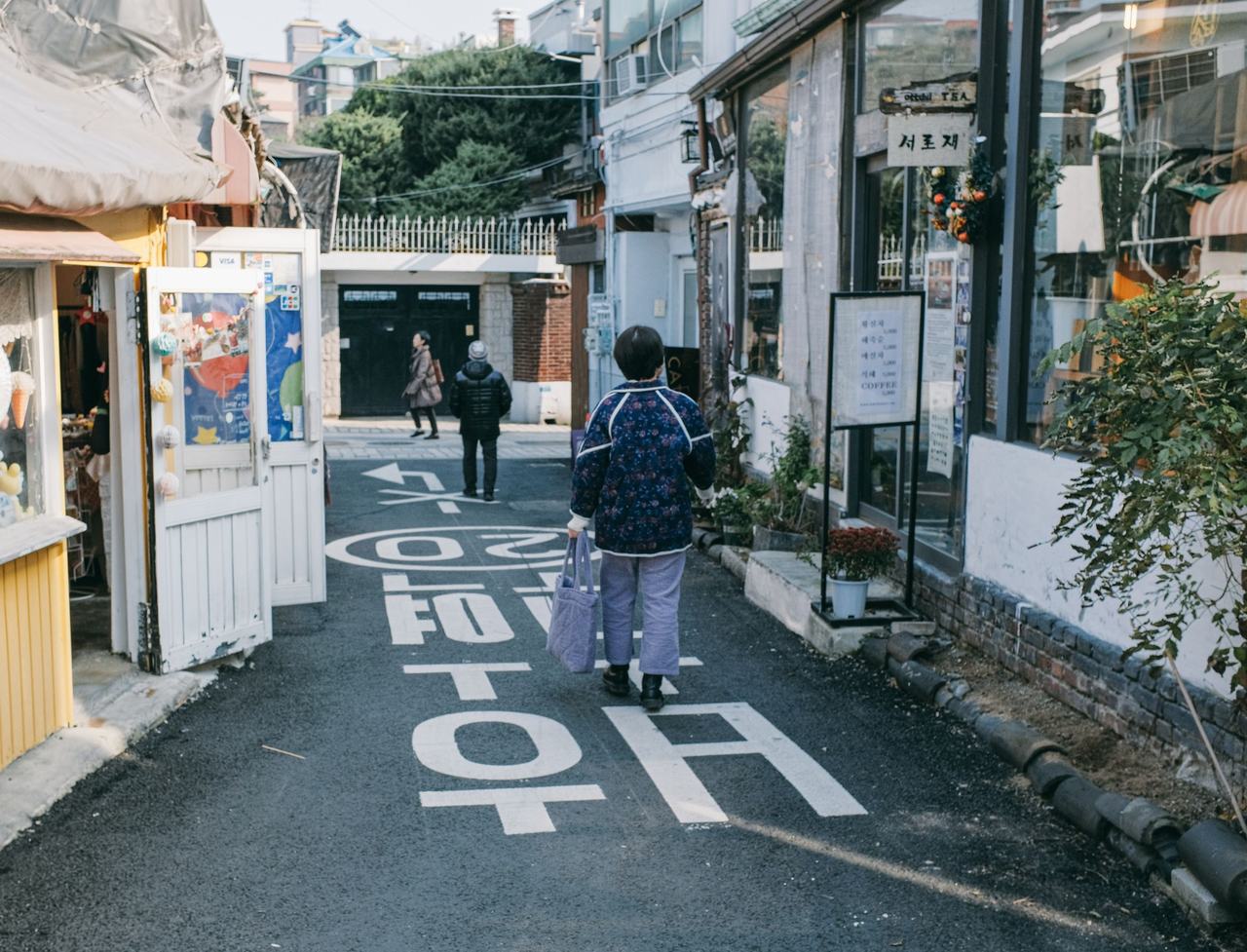
Opening photograph: A woman carrying a shopping bag walks away down a narrow lane of small shops in Seoul. Photograph by Huy Phan on Pexels. Blog photo credits.