Yeogiyo vs Jeogiyo: How to Get Attention in Korea
To get a clerk’s or a stranger’s attention in Korea, say 저기요 (jeogiyo). That is the course’s own note on it, and it is the word to use in a store or on the street. To call a server over to your restaurant table, the course uses yeogiyo instead: 여기요, 물 좀 주세요, excuse me, some water, please. Yeogiyo has a second job too. When someone hands you something, it means “here you go,” and when a taxi driver asks it, it means “here?”
Jeogiyo: excuse me for clerks and strangers
Jeogiyo is the word that makes someone turn around. You say it before your question, and the question follows straight on:
You say
저기요.
jeogiyo.
Excuse me.
To get a clerk’s or a stranger’s attention.
At the convenience store, Jimin, the barista, is shopping for milk and stops Junho, the clerk:
Jimin, the barista, asks
저기요, 우유 어디 있어요?
jeogiyo, uyu eodi isseoyo?
Excuse me, where’s the milk?
Junho, the store clerk, says
저쪽 냉장고에 있어요.
jeojjok naengjanggoe isseoyo.
It’s in the fridge over there.
Notice the shape. Jeogiyo, then the thing, then eodi isseoyo, where is it. You can reuse it for anything on a shelf. The course gives you this one, useful in any convenience store:
You ask
저기요, 라면 어디 있어요?
jeogiyo, ramyeon eodi isseoyo?
Excuse me, where’s the ramen?
It works the same way on the street. Tom, a Canadian exchange student, stops Seoyeon to ask the way to the subway, and jeogiyo is how he starts:
Tom, an exchange student, asks
저기요, 지하철역 어디예요?
jeogiyo, jihacheollyeok eodiyeyo?
Excuse me, where’s the subway station?
You do not need anything before it. In the course, jeogiyo is always the first word, and the question comes right after it, so it doubles as a signal that a question is on its way.
Yeogiyo: calling a server to your table
At a restaurant, the course switches to yeogiyo. You are seated, the server is somewhere across the room, and you want them to come to you. The course pairs it with a request for water:
You say
여기요, 물 좀 주세요.
yeogiyo, mul jom juseyo.
Excuse me, some water, please.
Here is how the exchange runs in the course’s restaurant scene. When you call, Choi, the owner, answers with a quick yes and a question. Then, if what you asked for is water, you may get this answer:
The restaurant owner asks
네, 뭐 필요하세요?
ne, mwo piryohaseyo?
Yes, what do you need?
The restaurant owner says
물은 셀프예요. 저기 있어요.
mureun selpeuyeyo. jeogi isseoyo.
Water’s self-service. It’s over there.
The course note on water explains that reply: water is often self-service, and the owner is telling you where to find it.
Many Korean restaurants also have a small call bell on the table for signaling staff. If you see one, pressing it calls someone over, and you can make your request when they arrive.
Yeogiyo as “here you go”
This is the part that can be confusing. The same word you use to call a server is also what people say when they hand you something. The course has it from the very first lesson, when Jimin passes a coffee across the counter:
Jimin, the barista, says
여기요.
yeogiyo.
Here you go.
And later, when she offers the receipt and you say yes:
Jimin, the barista, asks
영수증 드릴까요?
yeongsujeung deurilkkayo?
Would you like the receipt?
Jimin, the barista, says
여기요.
yeogiyo.
Here you go.
The course translates all of these as “here you go.” Context does the work: if someone is holding something out to you, yeogiyo is “here you go.” If someone at a table is looking around for staff, it is “excuse me.” You will also say it yourself when you hand something over, the way Minjun does in the course when he gives something back to a coworker.
Yeogiyo as “here?” in a taxi
At the end of a taxi ride, yeogiyo turns into a question. You have asked the driver to stop in front of a convenience store, and as he pulls up he checks:
The taxi driver asks
여기요?
yeogiyo?
Here?
Minjun, a friend, says
네, 여기서 세워 주세요.
ne, yeogiseo sewo juseyo.
Yes, stop here, please.
Here it is a question. Your answer is the yes from the course, ne, followed by stop here, please. In other course lines, yeogi means here and jeogi means over there: jeogi byeoge isseoyo, it’s on the wall over there. One way to remember which word fits: yeogiyo calls someone to where you are, and jeogiyo reaches out to someone a little way off.
Jamkkanmannyo: excuse me, can I get past
There is a third “excuse me” that is neither of these. When you need someone to wait for you, or to let you through a crowded aisle or a busy subway door, the course gives you jamkkanmannyo:
You say
잠깐만요.
jamkkanmannyo.
One moment, please.
Also excuse me, when you need someone to wait or let you past.
Its main meaning is “one moment, please.” As an excuse me, it is for moving, not for asking. To ask a question, go back to jeogiyo. If you have actually bumped into someone, that calls for an apology instead; see sorry in Korean.
A quick guide to which one to use
- A clerk in a store, or a stranger on the street: 저기요.
- A server, when you are sitting at your table: yeogiyo, as in 여기요, 물 좀 주세요.
- Handing something over: yeogiyo, here you go.
- Getting past someone, or asking them to wait: 잠깐만요.
Every line on this page is a recording from Sori’s course. In the app you hear each line, say it out loud and see what it heard, which is a good way to tell the two words apart by ear as well as by meaning.
Every line on this page
The 14 lines above, in order, for one last listen before you go. Each one is the recording from the Sori course.
저기요.jeogiyo.Excuse me.
저기요, 우유 어디 있어요?jeogiyo, uyu eodi isseoyo?Excuse me, where’s the milk?
저쪽 냉장고에 있어요.jeojjok naengjanggoe isseoyo.It’s in the fridge over there.
저기요, 라면 어디 있어요?jeogiyo, ramyeon eodi isseoyo?Excuse me, where’s the ramen?
저기요, 지하철역 어디예요?jeogiyo, jihacheollyeok eodiyeyo?Excuse me, where’s the subway station?
여기요, 물 좀 주세요.yeogiyo, mul jom juseyo.Excuse me, some water, please.
네, 뭐 필요하세요?ne, mwo piryohaseyo?Yes, what do you need?
물은 셀프예요. 저기 있어요.mureun selpeuyeyo. jeogi isseoyo.Water’s self-service. It’s over there.
여기요.yeogiyo.Here you go.
영수증 드릴까요?yeongsujeung deurilkkayo?Would you like the receipt?
여기요.yeogiyo.Here you go.
여기요?yeogiyo?Here?
네, 여기서 세워 주세요.ne, yeogiseo sewo juseyo.Yes, stop here, please.
잠깐만요.jamkkanmannyo.One moment, please.
Common questions
What is the difference between yeogiyo and jeogiyo?
In the course, jeogiyo gets a clerk’s or a stranger’s attention, and yeogiyo calls a server to your table. Yeogiyo also means “here you go” when someone hands you something, and “here?” as a question.
How do you call a waiter in Korea?
The course uses yeogiyo, often with the request straight after it: 여기요, 물 좀 주세요. Many restaurants also have a call bell on the table for signaling staff.
What does yeogiyo mean when someone gives you something?
It means “here you go.” The course has the barista say it as she hands over a drink and the receipt, and you can say it yourself when you hand something to someone.
How do you say excuse me to get past someone in Korean?
Say 잠깐만요. The course notes that it also means excuse me when you need someone to wait or let you past.
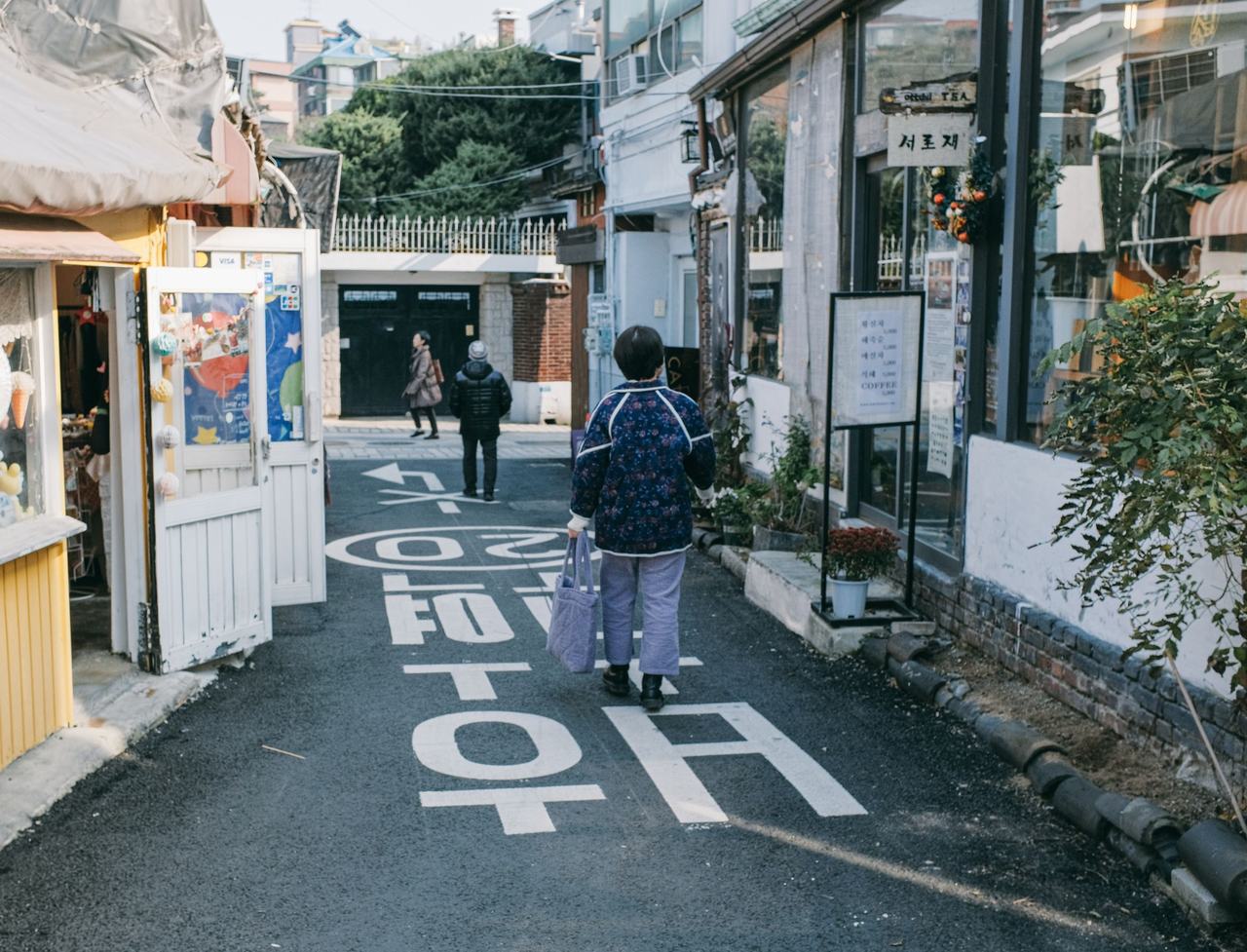
Opening photograph: A woman carrying a shopping bag walks away down a narrow lane of small shops in Seoul. Photograph by Huy Phan on Pexels. Blog photo credits.