How to Pay and Split the Bill in Korean
To split the bill in Korean, say 따로 계산할게요, “we’ll pay separately.” To pay as one group, say 같이 계산할게요, “we’ll pay together.” You will usually be choosing between the two because the owner asks first: gachi gyesanhae deurilkkayo, “shall I put it all together?” The request that starts it all is 계산해 주세요, “I’d like to pay, please.” Below is the whole exchange from Sori’s restaurant unit, at the counter by the door, with recordings of both sides.
Asking for the bill
The course notes that in most Korean restaurants you pay at the counter by the door. So asking for the bill is often something you say as you walk up to the counter, not something you call across the room.
You say
계산해 주세요.
gyesanhae juseyo.
I’d like to pay, please.
In most Korean restaurants you pay at the counter by the door.
Gyesan is the bill, or paying, as the course notes in its convenience store unit, and gyesanhae juseyo asks for it. In the restaurant scene, the customer puts a thank-you for the meal in front of it, which is a natural way to open:
Minjun, a friend, says
잘 먹었습니다. 계산해 주세요.
jal meogeotseumnida. gyesanhae juseyo.
Thank you for the meal. The bill, please.
Jal meogeotseumnida is a set phrase, the course notes, said as you leave a restaurant or to whoever paid. There is more on it in what to say after a meal in Korea.
Together or separately: the question at the counter
When there is more than one of you, expect this question:
The restaurant owner asks
같이 계산해 드릴까요?
gachi gyesanhae deurilkkayo?
Shall I put it all together?
Gachi means together, and gyesanhae deurilkkayo is the owner offering to ring it up. You answer with one of these two lines:
You say
같이 계산할게요.
gachi gyesanhalgeyo.
We’ll pay together.
You say
따로 계산할게요.
ttaro gyesanhalgeyo.
We’ll pay separately.
The two lines are identical apart from the first word: gachi for together, ttaro for separately. If you are splitting, the course’s own answer adds aniyo, no, in front, since the question was “shall I put it all together?”
The per-person total
Here is how it plays out in the course. The customer says no, they will pay separately, and the owner works out the share:
Minjun, a friend, says
아니요, 따로 계산할게요.
aniyo, ttaro gyesanhalgeyo.
No, we’ll pay separately.
The restaurant owner says
네, 한 분에 만 원씩이에요.
ne, han bune man wonssigieyo.
Okay, it’s 10,000 won each.
Han bune man wonssigieyo means “it’s 10,000 won each.” The course explanation spells it out: 한 분에 만 원씩, 10,000 won each. 분 is the same polite word for people you heard at the door, when the owner asked myeot buniseyo. The amount in the middle is the part to listen for. Man won is 10,000 won, and the course notes that Korean counts in ten thousands, so man is 10,000.
Your own amount will be different, of course. If prices in won are new to you, how to say and understand prices in Korean won covers how the numbers sound.
Card or cash
With the amount settled, say how you are paying. Both lines come from the course and work at any counter:
You say
카드로 할게요.
kadeuro halgeyo.
I’ll pay by card.
You say
현금으로 할게요.
hyeongeumeuro halgeyo.
I’ll pay in cash.
Kadeuro halgeyo is “I’ll pay by card,” and hyeongeumeuro halgeyo is “I’ll pay in cash.” If you pay by card, the next thing you hear is an instruction about the card reader. At the café counter in the course, it is this:
Jimin, the barista, says
네, 카드 꽂아 주세요.
ne, kadeu kkoja juseyo.
Okay, insert your card, please.
Kadeu kkoja juseyo means “insert your card, please.” Listen for the last word: with some readers you tap instead, and the taxi driver in the course says yeogi dae juseyo, tap it here. If you want a receipt, ask for it, or wait for the offer, which the barista in the course makes with yeongsujeung deurilkkayo, would you like the receipt?
You say
영수증 주세요.
yeongsujeung juseyo.
The receipt, please.
When you are splitting, each person simply says their own kadeuro halgeyo or hyeongeumeuro halgeyo in turn, with the per-person amount the owner gave.
No tip, and the goodbye at the counter
Tipping is not customary in Korea, and service is included in the bill. The amount the owner says is the amount you pay.
As you leave, the owner sees you off. In the course it sounds like this:
The restaurant owner says
감사합니다. 또 오세요.
gamsahamnida. tto oseyo.
Thank you. Come again.
You say
안녕히 계세요.
annyeonghi gyeseyo.
Goodbye. (You are leaving.)
Said by the one who leaves to the one who stays: stay in peace.
Gamsahamnida. Tto oseyo means “thank you, come again.” Your answer is the goodbye for the person leaving, annyeonghi gyeseyo, which the course explains is said by the one who leaves to the one who stays. Or say jal meogeotseumnida on your way out: the course notes it is said as you leave a restaurant, and it thanks the owner for the meal.
The counter exchange in order
Here is the sequence the way the course runs it:
- At the counter, you say gyesanhae juseyo, or jal meogeotseumnida. gyesanhae juseyo.
- The owner asks gachi gyesanhae deurilkkayo?
- You say gachi gyesanhalgeyo to pay together, or aniyo, ttaro gyesanhalgeyo to split.
- If you split, the owner gives the share: han bune man wonssigieyo, with your amount.
- You say kadeuro halgeyo or hyeongeumeuro halgeyo.
- The owner says gamsahamnida. tto oseyo. You say annyeonghi gyeseyo.
Every line on this page is a recording from Sori’s course. In the app you hear each one, say it out loud and see what it heard, so ttaro gyesanhalgeyo is ready when the question comes.
Every line on this page
The 13 lines above, in order, for one last listen before you go. Each one is the recording from the Sori course.
계산해 주세요.gyesanhae juseyo.I’d like to pay, please.
잘 먹었습니다. 계산해 주세요.jal meogeotseumnida. gyesanhae juseyo.Thank you for the meal. The bill, please.
같이 계산해 드릴까요?gachi gyesanhae deurilkkayo?Shall I put it all together?
같이 계산할게요.gachi gyesanhalgeyo.We’ll pay together.
따로 계산할게요.ttaro gyesanhalgeyo.We’ll pay separately.
아니요, 따로 계산할게요.aniyo, ttaro gyesanhalgeyo.No, we’ll pay separately.
네, 한 분에 만 원씩이에요.ne, han bune man wonssigieyo.Okay, it’s 10,000 won each.
카드로 할게요.kadeuro halgeyo.I’ll pay by card.
현금으로 할게요.hyeongeumeuro halgeyo.I’ll pay in cash.
네, 카드 꽂아 주세요.ne, kadeu kkoja juseyo.Okay, insert your card, please.
영수증 주세요.yeongsujeung juseyo.The receipt, please.
감사합니다. 또 오세요.gamsahamnida. tto oseyo.Thank you. Come again.
안녕히 계세요.annyeonghi gyeseyo.Goodbye. (You are leaving.)
Common questions
How do you say “separate checks” in Korean?
Say 따로 계산할게요, “we’ll pay separately.” If the owner has just asked whether to put it all together, add aniyo, no, in front, as the course does.
How do you ask for the bill in Korean?
Say 계산해 주세요, “I’d like to pay, please.” The course notes that in most Korean restaurants you pay at the counter by the door, so you usually say it there.
What does “gachi gyesanhae deurilkkayo” mean?
It means “shall I put it all together?” It is the owner asking whether your group is paying as one. Answer 같이 계산할게요 to pay together, or 따로 계산할게요 to split.
Do you tip at restaurants in Korea?
No. Tipping is not customary in Korea, and service is included in the bill. A thank-you is what you leave instead: jal meogeotseumnida, thank you for the meal.
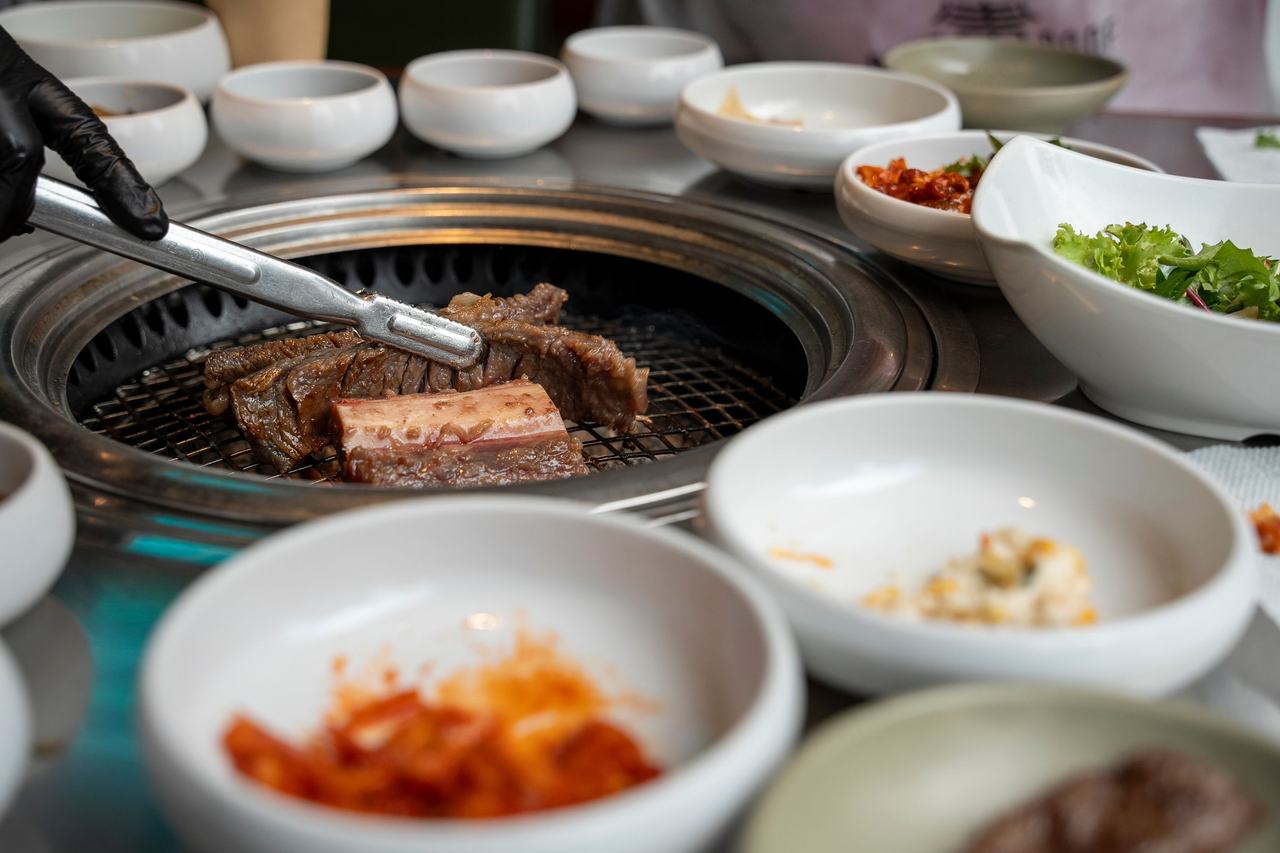
Opening photograph: Ribs sizzle on a tabletop grill surrounded by small bowls of side dishes at a Korean barbecue restaurant in Seoul. Photograph by Pincalo on Pexels. Blog photo credits.