How to Introduce Yourself in Korean as a Visitor
To introduce yourself in Korean, you need four short lines: 안녕하세요 (hello), your name with ieyo or yeyo on the end, as in 저는 톰이에요 (I’m Tom), 이름이 뭐예요? (what’s your name?), and 만나서 반가워요 (nice to meet you). That is a complete, friendly introduction for meeting someone your own age on a trip, at a language exchange or through a friend. The only part that changes is your name, and the ending that goes after it.
A four-line introduction you can actually say
Here is the whole thing in order. Listen to each line and notice how short it is. None of them needs any grammar beyond swapping in your name.
You say
안녕하세요.
annyeonghaseyo.
Hello.
The everyday polite hello, for anyone, at any time of day.
You say
저는 톰이에요.
jeoneun tomieyo.
I’m Tom.
You ask
이름이 뭐예요?
ireumi mwoyeyo?
What’s your name?
Friendly and polite, for people about your age.
You say
만나서 반가워요.
mannaseo bangawoyo.
Nice to meet you.
Literally: I’m glad to meet you.
The course’s note on the hello is worth repeating: it is the everyday polite hello, for anyone, at any time of day. You do not need a separate good morning or good evening. And the name question is friendly and polite, for people about your age, which suits a language exchange or a friend of a friend.
In the course’s scenes, people do not say all four lines in one go. They split them into turns, and nice to meet you comes once both names are out. Doing the same gives the other person room to answer, and it makes each of your turns only a few words long.
Saying your name: ieyo or yeyo
This is the one part that needs a moment of thought. After your name comes a small ending, and it has two forms. The course notes put the rule simply:
You say
저는 지민이에요.
jeoneun jiminieyo.
I’m Jimin.
After a name that ends in a consonant, say 이에요.
You say
저는 리사예요.
jeoneun risayeyo.
I’m Lisa.
After a name that ends in a vowel, say 예요.
So Jimin, which ends in a consonant, takes ieyo: jiminieyo. Lisa, which ends in a vowel, takes yeyo: risayeyo. Tom follows Jimin:
You say
저는 톰이에요.
jeoneun tomieyo.
I’m Tom.
Now the useful surprise. What counts is how the name ends in Korean, not in English. Listen to these two:
You say
저는 케이트예요.
jeoneun keiteuyeyo.
I’m Kate.
You say
저는 마크예요.
jeoneun makeuyeyo.
I’m Mark.
In English, Kate and Mark both end in a consonant. In Korean they take yeyo, the ending for a vowel. The romanization shows why: the course writes them keiteuyeyo and makeuyeyo, and in Korean each name ends on a short vowel, which you can hear clearly in the recordings. Tom does not, as tomieyo shows: his name stays on its final consonant. So listen to how your own name sounds when a Korean speaker says it. If it closes like Tom’s, use ieyo. If it ends on a vowel like Kate’s or Mark’s, use yeyo.
You can also leave out the first word. In the course, Seoyeon says jeoneun seoyeonieyo, with jeoneun at the start, and Tom answers with just tomieyo. The course translates both as “I’m” plus the name.

Asking their name and hearing it back
An introduction goes both ways, so the line you hear matters as much as the line you say. In the course, Tom meets Seoyeon for the first time. Listen to how he opens, and how she answers and then asks him back:
Tom, an exchange student, asks
안녕하세요. 이름이 뭐예요?
annyeonghaseyo. ireumi mwoyeyo?
Hi. What’s your name?
Seoyeon, a coworker, asks
저는 서연이에요. 이름이 뭐예요?
jeoneun seoyeonieyo. ireumi mwoyeyo?
I’m Seoyeon. What’s your name?
Tom, an exchange student, says
톰이에요.
tomieyo.
I’m Tom.
Notice that Seoyeon gives her name and asks Tom’s in the same breath. That is a natural place to jump in with yours. If someone introduces themselves and then asks ireumi mwoyeyo?, your name with its ending is the whole answer.
Nice to meet you, and the reply
The last line is the warm one. The course gives the literal sense, I’m glad to meet you, and it pairs it with the reply you will hear back:
You say
만나서 반가워요.
mannaseo bangawoyo.
Nice to meet you.
You say
저도 반가워요.
jeodo bangawoyo.
Nice to meet you too.
Here it is in a real scene. Tom meets Jimin, the barista, on his first day working at her café. He folds his name and his nice to meet you into one turn:
Jimin, the barista, says
안녕하세요. 저는 지민이에요.
annyeonghaseyo. jeoneun jiminieyo.
Hi. I’m Jimin.
Tom, an exchange student, says
안녕하세요. 톰이에요. 만나서 반가워요.
annyeonghaseyo. tomieyo. mannaseo bangawoyo.
Hi. I’m Tom. Nice to meet you.
Jimin, the barista, says
저도 반가워요.
jeodo bangawoyo.
Nice to meet you too.
There is also a more formal version. The course notes that it is a set phrase for a manager, a teacher or a first meeting at work. As a visitor meeting people socially you will rarely need it, but it helps to recognize it:
You say
반갑습니다.
bangapseumnida.
Nice to meet you. (formal)
A set phrase: for a manager, a teacher or a first meeting at work.
If you are joining something for a while, such as a class or a group, the course has one more line for the start. Its note explains who says it and what the others say back:
You say
잘 부탁드려요.
jal butakdeuryeoyo.
I look forward to working with you.
Said when you start something together: a new job, a class, a team. The newcomer says 잘 부탁드려요; 잘 부탁해요, a little less humble, is what the others say back.
Adding where you are from
In the course, the question that follows names is where you are from. It is taught in the same unit as the introduction, so it fits naturally as a fifth line. The question is eodieseo wasseoyo?, and the answer is your country plus eseo wasseoyo. The full set of answers for different countries is in our guide to where are you from in Korean.
Put together, a full introduction from the course looks like this: hello, I’m Kate, what’s your name, nice to meet you, and then the where-from question when it comes. Five short turns, each one a line you can learn whole.
Every line on this page is a recording from Sori’s course. In the app you hear each line, say it out loud and see what it heard, so you can rehearse your own name with the right ending until it feels like yours.
Every line on this page
The 17 lines above, in order, for one last listen before you go. Each one is the recording from the Sori course.
안녕하세요.annyeonghaseyo.Hello.
저는 톰이에요.jeoneun tomieyo.I’m Tom.
이름이 뭐예요?ireumi mwoyeyo?What’s your name?
만나서 반가워요.mannaseo bangawoyo.Nice to meet you.
저는 지민이에요.jeoneun jiminieyo.I’m Jimin.
저는 리사예요.jeoneun risayeyo.I’m Lisa.
저는 케이트예요.jeoneun keiteuyeyo.I’m Kate.
저는 마크예요.jeoneun makeuyeyo.I’m Mark.
안녕하세요. 이름이 뭐예요?annyeonghaseyo. ireumi mwoyeyo?Hi. What’s your name?
저는 서연이에요. 이름이 뭐예요?jeoneun seoyeonieyo. ireumi mwoyeyo?I’m Seoyeon. What’s your name?
톰이에요.tomieyo.I’m Tom.
저도 반가워요.jeodo bangawoyo.Nice to meet you too.
안녕하세요. 저는 지민이에요.annyeonghaseyo. jeoneun jiminieyo.Hi. I’m Jimin.
안녕하세요. 톰이에요. 만나서 반가워요.annyeonghaseyo. tomieyo. mannaseo bangawoyo.Hi. I’m Tom. Nice to meet you.
저도 반가워요.jeodo bangawoyo.Nice to meet you too.
반갑습니다.bangapseumnida.Nice to meet you. (formal)
잘 부탁드려요.jal butakdeuryeoyo.I look forward to working with you.
Common questions
How do you say “my name is” in Korean?
Say your name plus ieyo or yeyo, with jeoneun in front if you like: 저는 지민이에요, I’m Jimin. The course uses this “I’m” form in every introduction.
What is the difference between ieyo and yeyo?
The course notes that ieyo goes after a name ending in a consonant and yeyo after a name ending in a vowel. What matters is how the name ends in Korean: Kate and Mark both take yeyo.
How do you say nice to meet you in Korean?
Say 만나서 반가워요. The reply is 저도 반가워요, nice to meet you too. For a manager, a teacher or a first meeting at work, the course gives the more formal 반갑습니다.
How do you ask someone’s name in Korean?
Ask 이름이 뭐예요?. The course notes that it is friendly and polite, for people about your age.
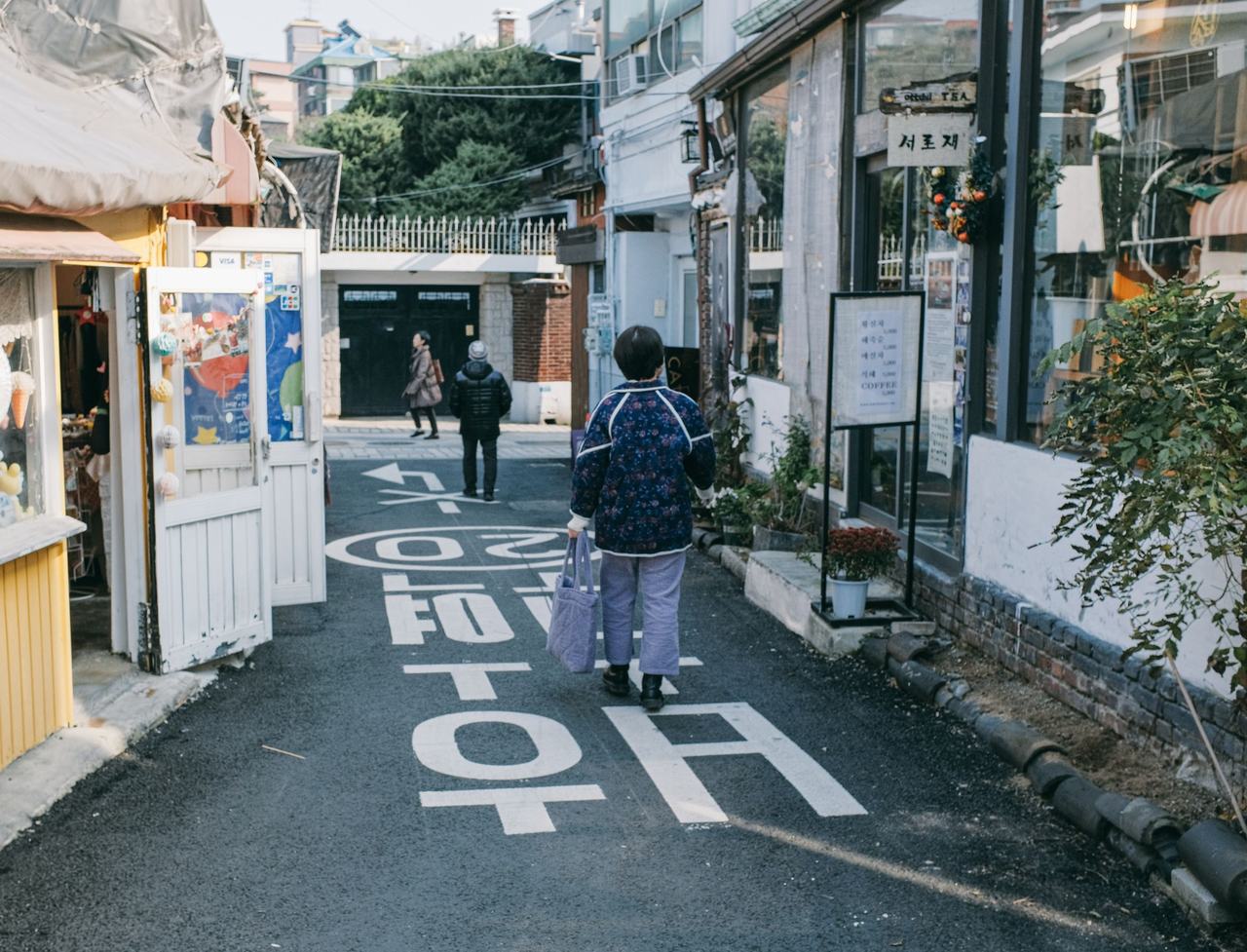
Opening photograph: A woman carrying a shopping bag walks away down a narrow lane of small shops in Seoul. Photograph by Huy Phan on Pexels. Blog photo credits.