How to Tell Time in Korean: Hours and Minutes
To ask the time in Korean, say 지금 몇 시예요? (jigeum myeot siyeyo?), what time is it? The answer puts the hour in native Korean numbers with si, and the minutes in Sino-Korean numbers with bun: 두 시 십오 분이에요 is “it’s a quarter past two.” Half past is ban, so 세 시 반이에요 is 3:30. To ask when something starts, the course uses 영화 몇 시에 시작해요?, what time does the film start? That handful of lines covers most of what a visitor needs from a clock.
Asking what time it is
The question is short. The course’s note explains its key word:
You ask
지금 몇 시예요?
jigeum myeot siyeyo?
What time is it?
몇 시: what hour. Hours are counted in native Korean numbers: 한 시, 두 시, 세 시, 네 시.
Jigeum is “now,” and myeot si is “what hour.” In the course, Minjun and Seoyeon are waiting for a film. He asks the time, and she answers:
Minjun, a friend, asks
지금 몇 시예요?
jigeum myeot siyeyo?
What time is it?
Seoyeon, a coworker, says
세 시 반이에요.
se si banieyo.
It’s half past three.
Her answer, se si banieyo, is the shape of almost every time you will hear: the hour, then si, then the minutes, then the ending.
Hours: native Korean numbers
The hour on a clock uses the native numbers, the same set you use for counting cups or people. The course note above lists the first four: han si, du si, se si, ne si. That is one, two, three and four o’clock.
If those look familiar, it is because they are the same short forms the course uses for counting, as in han gae, one thing, or du jan, two cups. Our guide to native vs Sino Korean numbers has the full split between the two systems.
Here are two more times, both with ban, half. Notice that only the hour changes:
You say
한 시 반이에요.
han si banieyo.
It’s half past one.
You say
세 시 반이에요.
se si banieyo.
It’s half past three.
반: half. Minutes take Sino-Korean numbers: 세 시 십오 분 is 3:15.
Minutes: Sino-Korean numbers
Minutes switch to the other set. The course explains this in its time unit: hours take native numbers, and minutes take Sino-Korean ones. So a quarter past two mixes both:
You say
두 시 십오 분이에요.
du si sibo bunieyo.
It’s a quarter past two.
Native hour, Sino-Korean minutes: 두 시, then 십오 분.
Du si is native two for the hour. Sibo bun is Sino-Korean fifteen for the minutes. The note on half past three gives one more example, 3:15, with the same pattern. It feels odd the first time, but every time in the course follows this rule, so once you have one time, you have them all.
You meet Sino-Korean minutes outside the clock too. When someone says something is five minutes away on foot, or a delivery will take forty minutes, the minutes use the same set.
To read a time off a ticket or a sign, then, work in two steps:
- Say the hour with a native number and si: du si, two o’clock.
- Add the minutes with a Sino-Korean number and bun, or just ban for half past: sibo bun, fifteen minutes.
If the minutes are zero, stop after step one. Ne si, four o’clock, is a complete time on its own, as the film’s start time shows below.
What time does it start? Films and concerts
On a trip, the time question you need is often not “what time is it” but “what time does it start.” The course teaches it with a film, and its note explains the two new pieces:
You ask
영화 몇 시에 시작해요?
yeonghwa myeot sie sijakaeyo?
What time does the film start?
에 after a time: at. 시작해요: it starts.
You say
네 시에 시작해요.
ne sie sijakaeyo.
It starts at four.
The answer repeats the question’s shape: the hour, then e, at, then sijakaeyo, it starts. For a show, swap the film for a concert:
You ask
콘서트 몇 시에 시작해요?
konseoteu myeot sie sijakaeyo?
What time does the concert start?
The same question works for anything that starts at a set time. In the course’s role play, Seoyeon asks about a meeting:
Seoyeon, a coworker, asks
회의 몇 시에 시작해요?
hoeui myeot sie sijakaeyo?
What time does the meeting start?
Morning, afternoon and night
To say which part of the day you mean, the course puts a word in front of the hour. Its note on making plans gives the two you need for a.m. and p.m.:
You ask
오후 세 시 어때요?
ohu se si eottaeyo?
How about 3 p.m.?
오후: afternoon, p.m. 오전: morning, a.m. 어때요?: how about it?
So ohu se si is 3 p.m., and 오전 in front would make it a.m. For the evening, the course uses words for parts of the day instead, as in this café’s closing time:
You say
밤 열 시까지 해요.
bam yeol sikkaji haeyo.
We’re open until 10 at night.
아침: morning. 저녁: evening. 밤: night.
Bam yeol si is ten at night. The note gives achim for morning and jeonyeok for evening as well. In the course, these come up in opening hours and in making plans, so they are worth recognizing even if you only say one or two of them.
How much time is left
Once you know the time, the natural next line is how long you have. Back at the film, Minjun works it out. The film starts at four, it is half past three, so:
Minjun, a friend, says
그럼 아직 삼십 분 남았어요.
geureom ajik samsip bun namasseoyo.
Then we still have thirty minutes.
Samsip bun is thirty minutes, Sino-Korean again because it is minutes. In the role play, Seoyeon says a shorter version when she learns the meeting is not starting yet:
Seoyeon, a coworker, says
그럼 아직 시간 있네요.
geureom ajik sigan inneyo.
Then we still have time.
Every line on this page is a recording from Sori’s course. In the app you hear each line, say it out loud and see what it heard. Times are a good thing to drill this way, because the switch from native hours to Sino-Korean minutes needs to happen without a pause.
Every line on this page
The 14 lines above, in order, for one last listen before you go. Each one is the recording from the Sori course.
지금 몇 시예요?jigeum myeot siyeyo?What time is it?
지금 몇 시예요?jigeum myeot siyeyo?What time is it?
세 시 반이에요.se si banieyo.It’s half past three.
한 시 반이에요.han si banieyo.It’s half past one.
세 시 반이에요.se si banieyo.It’s half past three.
두 시 십오 분이에요.du si sibo bunieyo.It’s a quarter past two.
영화 몇 시에 시작해요?yeonghwa myeot sie sijakaeyo?What time does the film start?
네 시에 시작해요.ne sie sijakaeyo.It starts at four.
콘서트 몇 시에 시작해요?konseoteu myeot sie sijakaeyo?What time does the concert start?
회의 몇 시에 시작해요?hoeui myeot sie sijakaeyo?What time does the meeting start?
오후 세 시 어때요?ohu se si eottaeyo?How about 3 p.m.?
밤 열 시까지 해요.bam yeol sikkaji haeyo.We’re open until 10 at night.
그럼 아직 삼십 분 남았어요.geureom ajik samsip bun namasseoyo.Then we still have thirty minutes.
그럼 아직 시간 있네요.geureom ajik sigan inneyo.Then we still have time.
Common questions
How do you ask what time it is in Korean?
Ask 지금 몇 시예요?. Jigeum is now, and the course notes that myeot si means what hour.
How do you say half past in Korean?
Add ban, half, after the hour: 세 시 반이에요 is half past three, and 한 시 반이에요 is half past one.
Why do Korean hours and minutes use different numbers?
That is simply how Korean tells time, and the course states the rule: hours take native numbers, and minutes take Sino-Korean ones. So 2:15 is 두 시 십오 분이에요, with native two and Sino-Korean fifteen.
How do you say a.m. and p.m. in Korean?
The course notes that ohu is afternoon or p.m., and 오전 is morning or a.m. They go before the hour: 오후 세 시 어때요? means how about 3 p.m.?
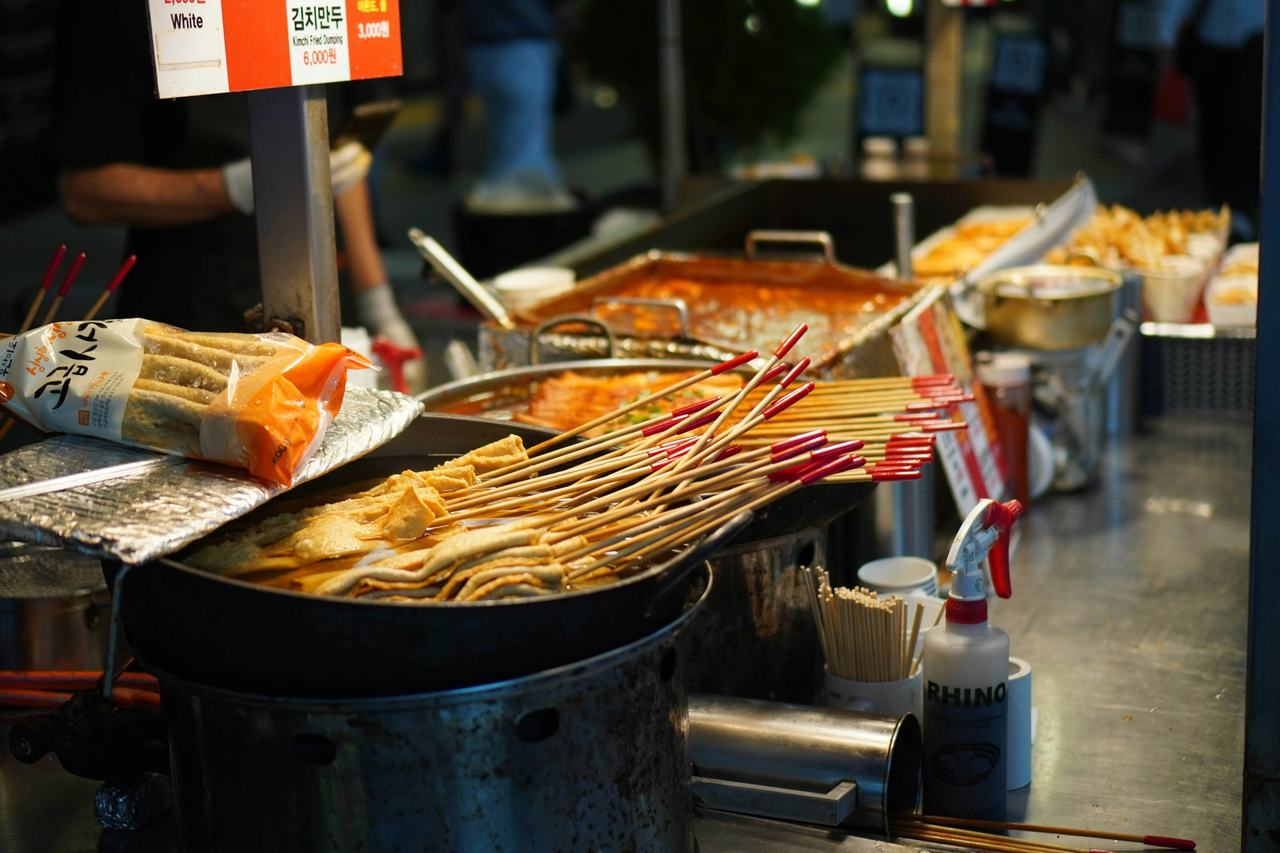
Opening photograph: Fish cake skewers simmering at a street food stall in Myeongdong, Seoul. Photograph by Irfan Syahmi on Unsplash. Blog photo credits.