Nihongo Jouzu: What It Means and How to Respond
Nihongo, ojōzu desu ne means “your Japanese is very good.” The answer the course teaches is modest: いえいえ、まだまだです, oh no, I still have a long way to go. Do not answer with どういたしまして, you’re welcome, because as the course notes, that would take the compliment as thanks. Then use the moment to keep talking: where you are from, how long you are staying, and a question back.
What the compliment sounds like
The course puts this line in a lunch scene. It is one of your first days at a partner studio in Kuramae, and Mori-san, a coworker, has been asking about you at the studio’s big table. After you answer a few questions in Japanese, she says:
Mori-san, a coworker, says
日本語、お上手ですね。
Nihongo, ojōzu desu ne.
Your Japanese is very good.
The course translates it simply as “Your Japanese is very good.” It comes after a round of getting-to-know-you questions, not as a test, and you do not need to analyze it. You need one reply ready, and then the next line of the conversation.
The modest reply: madamada desu
The course’s answer pushes the praise gently away. Its note calls it the modest answer to a compliment, and warns about one easy mistake:
You say
いえいえ、まだまだです。
Ieie, madamada desu.
Oh no, I still have a long way to go.
The modest answer to a compliment. どういたしまして would take it as thanks.
The first word, ieie, is useful on its own. The course’s note on it says it is the easy answer to thanks or to an apology, and it adds the same warning about どういたしまして: correct, but stiff and rare in Tokyo.
You say
いえいえ。
Ieie.
Not at all.
The easy answer to thanks or to an apology. どういたしまして is correct, but stiff and rare in Tokyo: people say いえいえ, or just smile.
Put together, Ieie, madamada desu is short and warm. It does not argue with the compliment and it does not accept it outright either, and the conversation can move on.
Keep it honest: a little Japanese, first time in Tokyo
If you want to add something after the modest reply, the course’s own lines from the same unit fit naturally. Both are true for most visitors, and both explain why your Japanese is still a work in progress without making a speech of it:
You say
日本語は少しだけ話せます。
Nihongo wa sukoshi dake hanasemasu.
I speak a little Japanese.
You say
東京は初めてです。
Tōkyō wa hajimete desu.
It’s my first time in Tokyo.
Either one hands the conversation back to the other person. They now know you are new here and learning, and the next question is easy for them to ask.

The questions that come next
In the course, the compliment sits among the first-meeting questions. The first is where you are from:
Mori-san, a coworker, asks
ご出身はどちらですか?
Goshusshin wa dochira desu ka?
Where are you from?
You say
アメリカから来ました。
Amerika kara kimashita.
I’m from the US.
Literally, I came from America.
If you are from somewhere else, the course also has イギリス出身です, I’m from the UK, and カナダ人です, I’m Canadian. Swap in your own country.
The second is how long you are in Tokyo. The course’s answer is about two months; use your own number of weeks or days.
Mori-san, a coworker, asks
東京にはどのくらいいるんですか?
Tōkyō ni wa donokurai irun desu ka?
How long are you in Tokyo?
You say
2か月ぐらいです。
Nikagetsu gurai desu.
About two months.
If you can answer these two smoothly, the compliment has done its job: it opened a real conversation. For the full set of lines for meeting someone, see how to introduce yourself in Japanese.
Turning the question back
A conversation is better when you ask too. In the course, Mori-san tells you she was born and raised in Tokyo:
Mori-san, a coworker, says
私は生まれも育ちも東京です。
Watashi wa umare mo sodachi mo Tōkyō desu.
I was born and raised in Tokyo.
The course’s way of turning a question back is to use the person’s name. Its note is firm on the alternative: never あなたは, which can sound cold, or oddly intimate.
You ask
森さんは?
Mori-san wa?
And you, Mori-san?
Turn a question back with the person’s name. Never あなたは?: it can sound cold, or oddly intimate.
That one move, the name and wa, works for each question on this page. The course repeats the advice in its casual unit, where you ask a new friend back with their name rather than a word for you, so it holds with friends as well as coworkers. She asks where you are from, you answer, and Mori-san wa? hands the question back.
Paying a compliment yourself
Compliments go both ways, and the course has a couple you can give. At the workshop downstairs, meeting Kenta, who makes leather goods, the course’s line praises his work:
You say
革の財布、素敵ですね。
Kawa no saifu, suteki desu ne.
Your leather wallets are lovely.
And for clothes, a bike or a person, the course offers a single word. Its note adds that to a friend you would drop the です.
You say
かっこいいですね。
Kakkoii desu ne.
That’s cool.
For clothes, bikes, people. To a friend you’d drop the です.
The whole exchange, start to finish
Here is one way the exchange can run with the course’s lines, so you can hear how short each turn is:
- Mori-san: 日本語、お上手ですね, your Japanese is very good.
- You: いえいえ、まだまだです, oh no, I still have a long way to go.
- You: 日本語は少しだけ話せます, I speak a little Japanese.
- Mori-san: ご出身はどちらですか?, where are you from?
- You: アメリカから来ました, then 森さんは?, and you?
- Mori-san: 私は生まれも育ちも東京です, born and raised in Tokyo.
- Mori-san: 東京にはどのくらいいるんですか?, how long are you here?
- You: 2か月ぐらいです, about two months.
None of your lines is longer than a few words. That is the point: a compliment on your Japanese is an invitation to use a little more of it, and these short turns are enough to accept the invitation.
Every line here is a recording from Koe’s course. In the app you hear Mori-san’s compliment, answer it out loud, and see what it heard, so madamada desu is ready the first time someone says it to you.
Every line on this page
The 13 lines above, in order, for one last listen before you go. Each one is the recording from the Koe course.
日本語、お上手ですね。Nihongo, ojōzu desu ne.Your Japanese is very good.
いえいえ、まだまだです。Ieie, madamada desu.Oh no, I still have a long way to go.
いえいえ。Ieie.Not at all.
日本語は少しだけ話せます。Nihongo wa sukoshi dake hanasemasu.I speak a little Japanese.
東京は初めてです。Tōkyō wa hajimete desu.It’s my first time in Tokyo.
ご出身はどちらですか?Goshusshin wa dochira desu ka?Where are you from?
アメリカから来ました。Amerika kara kimashita.I’m from the US.
東京にはどのくらいいるんですか?Tōkyō ni wa donokurai irun desu ka?How long are you in Tokyo?
2か月ぐらいです。Nikagetsu gurai desu.About two months.
私は生まれも育ちも東京です。Watashi wa umare mo sodachi mo Tōkyō desu.I was born and raised in Tokyo.
森さんは?Mori-san wa?And you, Mori-san?
革の財布、素敵ですね。Kawa no saifu, suteki desu ne.Your leather wallets are lovely.
かっこいいですね。Kakkoii desu ne.That’s cool.
Common questions
What does nihongo jouzu mean?
It means “your Japanese is good.” The course’s line is Nihongo, ojōzu desu ne, translated as your Japanese is very good. In the course, a coworker says it at lunch during your first days, after asking where you are from and how long you are staying.
How do you respond when someone says your Japanese is good?
With the modest answer the course teaches: いえいえ、まだまだです, oh no, I still have a long way to go. Then keep the conversation going with a question back, using the person’s name.
Should I say douitashimashite to a compliment?
No. The course notes that どういたしまして would take the compliment as thanks. It is also stiff and rare in Tokyo even as an answer to thanks, where people say ieie or just smile.
What does madamada desu mean?
It means “I still have a long way to go.” With ieie in front, it is the course’s modest reply to a compliment on your Japanese.
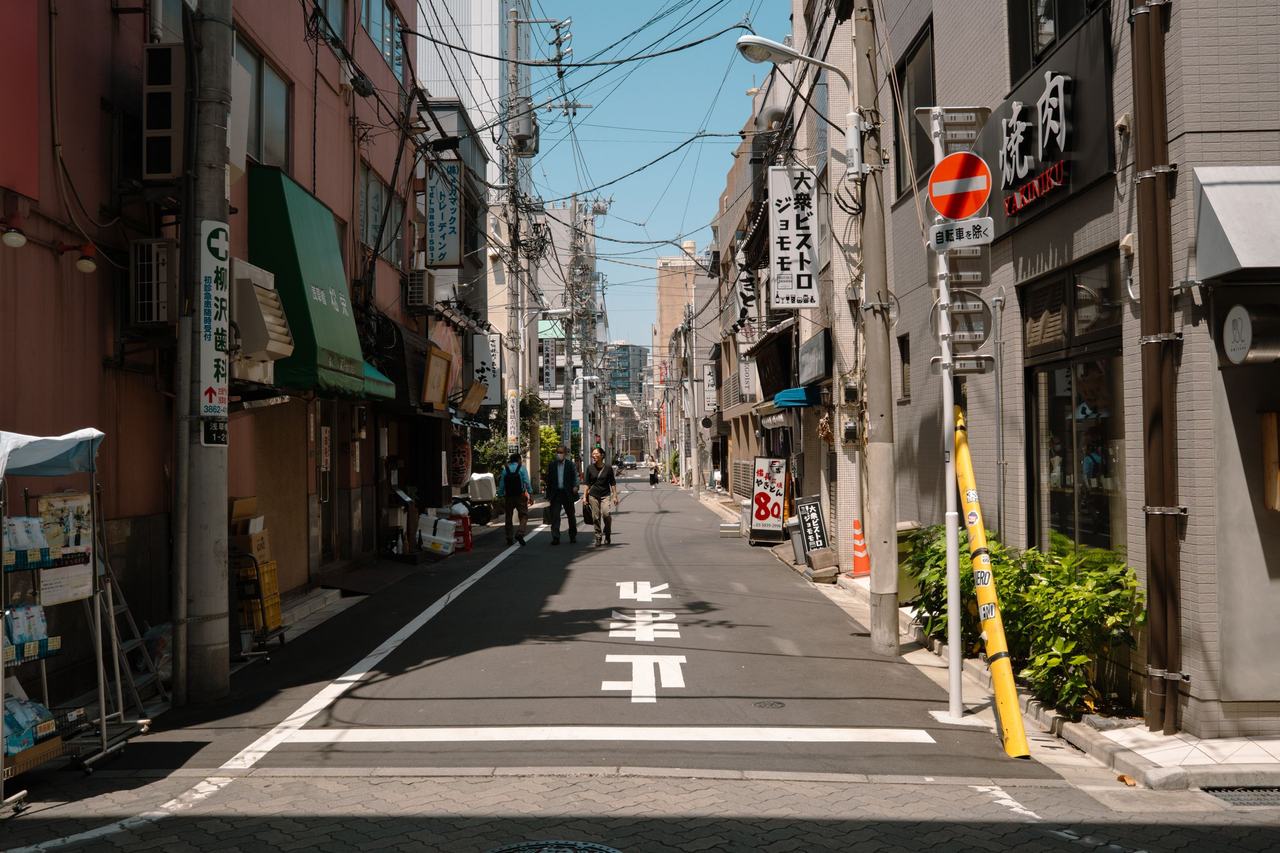
Opening photograph: A few people walk down a narrow, sunlit side street of small shops and overhead wires in Tokyo. Photograph by Iban Lopez Luna on Pexels. Blog photo credits.