How to Introduce Yourself in Japanese as a Visitor
To introduce yourself in Japanese, say はじめまして (nice to meet you), then your name with desu, where you are from, that it is your first time in Tokyo, and close with よろしくお願いします. Five short lines, all polite enough for anyone. The one rule the course insists on: never put san after your own name. You say your name plain, and you put san on the other person’s.
The five-line introduction
Here is the whole thing in order, using the course’s own lines. Swap in your own name and country.
- はじめまして, nice to meet you.
- Your name and desu, as in エマ・ブラウンです.
- Where you are from, as in アメリカから来ました.
- 東京は初めてです, it’s my first time in Tokyo.
- よろしくお願いします, to close.
That is a complete, polite introduction. The sections below go through each line, what you will hear back, and the small mistakes the course warns about.
Nice to meet you, and your name without san
The course sets this scene on your first morning at a partner studio in Kuramae, when Mori-san, a coworker, meets you at the door:
Mori-san, a coworker, says
はじめまして、森です。
Hajimemashite, Mori desu.
Nice to meet you, I’m Mori.
Notice that she says 森です, with no san. The course explains why: nobody puts さん on their own name. You say your name, and you call her 森さん.
You say
はじめまして。
Hajimemashite.
Nice to meet you.
The first words when you meet someone, with a small bow.
You say
エマ・ブラウンです。
Ema Buraun desu.
I’m Emma Brown.
Your own name, plain. Never エマさん: putting さん on your own name sounds like you’re honoring yourself. And there’s no need to start with 私は.
The note on that second line also says there is no need to start with 私は, I am. Your name and desu is enough. The course keeps a foreign name in its usual order, given name first, as in はじめまして、ダニエル・ミラーです, which also shows the first two lines run together in one breath. If you do not catch the other person’s name, ask again with すみません、お名前、もう一度いいですか?. The course’s line for it starts with sumimasen, so it stays polite even at a first meeting.
Saying where you are from
In the course this question comes at lunch during your first days, at the studio’s big table:
Mori-san, a coworker, asks
ご出身はどちらですか?
Goshusshin wa dochira desu ka?
Where are you from?
You say
アメリカから来ました。
Amerika kara kimashita.
I’m from the US.
Literally, I came from America.
The course gives two other shapes for the answer:
You say
イギリス出身です。
Igirisu shusshin desu.
I’m from the UK.
You say
カナダ人です。
Kanadajin desu.
I’m Canadian.
Pick whichever is easiest to say with your own country. Then you turn the question back, and Mori-san answers that she was born and raised in Tokyo. More on that below.
First time in Tokyo, and how long you are staying
The next two lines tell people what kind of visitor you are, and they are good conversation openers:
You say
東京は初めてです。
Tōkyō wa hajimete desu.
It’s my first time in Tokyo.
You say
日本語は少しだけ話せます。
Nihongo wa sukoshi dake hanasemasu.
I speak a little Japanese.
The second one is worth saying early. It is modest, it is true for most visitors, and it sets expectations before the conversation speeds up. If the other person then slows down for you, the introduction has done its job.
After that, expect a question about how long you are here. Mori-san asks it like this, and the course’s answer is about two months:
Mori-san, a coworker, asks
東京にはどのくらいいるんですか?
Tōkyō ni wa donokurai irun desu ka?
How long are you in Tokyo?
You say
2か月ぐらいです。
Nikagetsu gurai desu.
About two months.
If your Japanese goes well, you may hear a compliment at this point. There is a whole page on how to answer it: nihongo jouzu and how to respond.
Closing the introduction
The course closes its polite introductions with the same phrase. The course’s note says it is said to close an introduction, and that どうぞ in front makes it a little more formal:
You say
よろしくお願いします。
Yoroshiku onegai shimasu.
I look forward to working with you.
Said to close an introduction. どうぞ in front makes it a little more formal.
If the other person says it first, you answer with kochira koso, which turns it into “likewise”:
You say
こちらこそ、よろしくお願いします。
Kochira koso, yoroshiku onegai shimasu.
Likewise.
The answer to よろしくお願いします.
The course translates yoroshiku onegai shimasu as “I look forward to working with you” because its scene is a workplace. The note itself is broader: it is simply what you say to close an introduction.
Two more introductions: a first day and a phone call
If you are starting somewhere for a few days (a workshop, a class, a stay with people who will look after you), the course adds one more line to the introduction. Its note says it literally means I’ll be in your care from today, said on a first day to the people who’ll look after you:
You say
今日からお世話になります。
Kyō kara osewa ni narimasu.
I’ll be working with you from today.
Literally, I’ll be in your care from today. Said on a first day to the people who’ll look after you.
On the phone, introductions change shape. When you book a table, the course has you give your family name with a humbler verb, and its note warns against putting the honorific お on your own name:
You say
ブラウンと申します。
Buraun to mōshimasu.
My name is Brown.
Your family name, with the humble 申します. For your own name it’s 名前, never お名前はブラウンです: the お honors the other person.
Asking back, and what to call people
An introduction is a two-way thing, so turn the question around. The course’s note is firm about how: use the person’s name, never あなた, which can sound cold, or oddly intimate.
You ask
森さんは?
Mori-san wa?
And you, Mori-san?
Turn a question back with the person’s name. Never あなたは?: it can sound cold, or oddly intimate.
As for names, the course notes that at work people go by their family name with さん. A given name is used only when its owner offers it. In the course, Kenta, a friend from the workshop downstairs, does exactly that: Kenta de ii desu yo, just Kenta is fine. You can offer yours the same way, still without san:
You say
エマでいいですよ。
Ema de ii desu yo.
Just Emma is fine.
No さん: it’s your own name. A given name is used only when its owner offers it, as Kenta does.
If you are not sure what to call someone, the course has a direct question for it: なんて呼べばいいですか?, what should I call you?
Every line here is a recording from Koe’s course. In the app you hear each line, say it out loud, and see what it heard, which is a good way to make your own five lines automatic before your first meeting.
Every line on this page
The 17 lines above, in order, for one last listen before you go. Each one is the recording from the Koe course.
はじめまして、森です。Hajimemashite, Mori desu.Nice to meet you, I’m Mori.
はじめまして。Hajimemashite.Nice to meet you.
エマ・ブラウンです。Ema Buraun desu.I’m Emma Brown.
ご出身はどちらですか?Goshusshin wa dochira desu ka?Where are you from?
アメリカから来ました。Amerika kara kimashita.I’m from the US.
イギリス出身です。Igirisu shusshin desu.I’m from the UK.
カナダ人です。Kanadajin desu.I’m Canadian.
東京は初めてです。Tōkyō wa hajimete desu.It’s my first time in Tokyo.
日本語は少しだけ話せます。Nihongo wa sukoshi dake hanasemasu.I speak a little Japanese.
東京にはどのくらいいるんですか?Tōkyō ni wa donokurai irun desu ka?How long are you in Tokyo?
2か月ぐらいです。Nikagetsu gurai desu.About two months.
よろしくお願いします。Yoroshiku onegai shimasu.I look forward to working with you.
こちらこそ、よろしくお願いします。Kochira koso, yoroshiku onegai shimasu.Likewise.
今日からお世話になります。Kyō kara osewa ni narimasu.I’ll be working with you from today.
ブラウンと申します。Buraun to mōshimasu.My name is Brown.
森さんは?Mori-san wa?And you, Mori-san?
エマでいいですよ。Ema de ii desu yo.Just Emma is fine.
Common questions
Do you say san after your own name in Japanese?
No. The course notes that putting さん on your own name sounds like you are honoring yourself. Say your name plain, as in エマ・ブラウンです, and put san on the other person’s name.
How do you say where you are from in Japanese?
The course gives three ways: アメリカから来ました, I came from America; イギリス出身です, I’m from the UK; and カナダ人です, I’m Canadian. Swap in your own country.
What does yoroshiku onegai shimasu mean?
It closes an introduction. The course translates it as I look forward to working with you, and the reply is こちらこそ、よろしくお願いします, likewise.
Do I need to say watashi wa before my name?
No. The course notes there is no need to start with 私は. Your name and desu is a complete introduction.
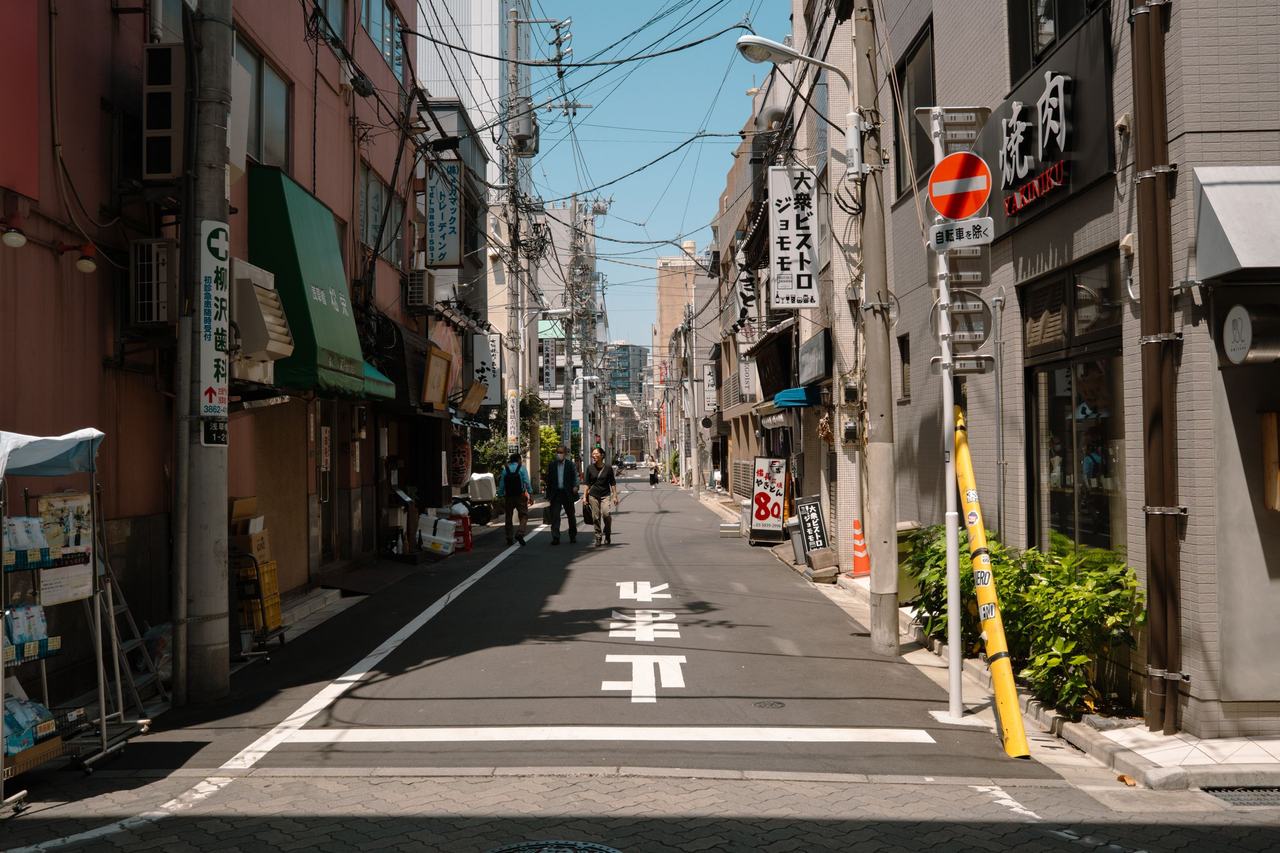
Opening photograph: A few people walk down a narrow, sunlit side street of small shops and overhead wires in Tokyo. Photograph by Iban Lopez Luna on Pexels. Blog photo credits.