Upset Stomach in Mexico City: The Spanish You Need
If your stomach is upset in Mexico City, the one line to know is Me duele el estómago (my stomach hurts). At a pharmacy, ask ¿Tiene algo para el dolor de estómago? (do you have something for a stomach ache?), then check the dose with ¿Cada cuánto lo tomo? (how often do I take it?). And if you need it in a hurry, ¿Dónde está el baño? (where’s the bathroom?). Below is the whole day in order, from telling someone what is wrong to resting up, with every line a recording from Habla’s feeling-unwell unit.
Telling someone what is wrong
When you look unwell, a friend or coworker may ask. In the course’s role play, Mariana asks it in two words, and the answer for a bad stomach is the line above:
Mariana, a coworker, asks
¿Qué tienes?
What’s wrong?
You say
Me duele el estómago.
My stomach hurts.
Friends say la panza, the belly.
¿Qué tienes? means what’s wrong. Me duele el estómago means my stomach hurts. The course’s note gives the friendly word you may hear back: la panza, the belly.
If you want to say the general thing first, before the specific one, the course has that too:
You say
No me siento bien.
I don’t feel well.
For more symptoms, from a headache to a sore throat, see how to say what hurts in Spanish.
Getting something at the pharmacy
In the course, when you tell Mariana what is wrong, one of her replies is exactly what you need to hear:
Mariana, a coworker, says
Uy. Hay una farmacia aquí en la esquina.
Oh no. There’s a pharmacy right here on the corner.
Hay una farmacia aquí en la esquina is there’s a pharmacy right here on the corner. At the counter, use the pattern the course teaches for anything at the pharmacy:
You ask
¿Tiene algo para el dolor de estómago?
Do you have something for a stomach ache?
The pharmacist may ask how much it hurts, ¿Le duele mucho?, and un poco, a little, is a fine answer. The rest of the counter exchange is in Spanish at a Mexican pharmacy.
Asking how to take it
Before you leave the counter, ask how to take what you bought. Two questions cover it:
You ask
¿Cada cuánto lo tomo?
How often do I take it?
You ask
¿Lo tomo con comida?
Do I take it with food?
The other answer you may get: en ayunas, on an empty stomach.
¿Cada cuánto lo tomo? is how often do I take it. ¿Lo tomo con comida? is do I take it with food. The note warns you about the other answer you might get: en ayunas, on an empty stomach. Listen for it. For the full set of dose questions, with how many days and how to check a number back, see understanding medicine instructions in Spanish.

Water, and lots of it
When the pharmacist in the course explains the medicine, she adds one more instruction:
Nora, the pharmacist, says
Y tome mucha agua.
And drink plenty of water.
Y tome mucha agua means and drink plenty of water. On a bad stomach day, that means a trip to the corner store for a bottle:
You say
Una botella de agua, por favor.
A bottle of water, please.
The store will ask ¿Chica o grande?: small or large.
As the note says, the store will ask ¿Chica o grande?, small or large. On a day like this, the large one is the answer.
Finding a bathroom fast
This is the line you will want ready before you need it. It is short, and it works in any café, restaurant or store:
You ask
¿Dónde está el baño?
Where’s the bathroom?
To a stranger, put disculpe, excuse me, in front. Then listen for the directions. In the course’s café, Sofía answers like this:
Sofía, the barista, says
Al fondo, a la derecha.
At the back, on the right.
Al fondo, a la derecha means at the back, on the right. A la izquierda would be on the left. Learn derecha, izquierda and al fondo and you can follow an answer like hers.
Resting, and when to see a doctor
Sometimes the right move is to go home. The course has a line for that, and its note explains the useful word at the front:
You say
Mejor me voy a mi casa.
I’d better go home.
Mejor plus what you’ll do: I’d better.
Mejor me voy a mi casa means I’d better go home. When you say what is wrong, a friend may suggest a remedy. In the course, Mariana suggests a chamomile tea:
Mariana, a coworker, says
Uy, pobre. Un té de manzanilla te va a caer bien.
Oh, poor you. A chamomile tea will do you good.
Uy, pobre is oh, poor you. Un té de manzanilla te va a caer bien is a chamomile tea will do you good.
If you had plans with someone, you will need to cancel them. You do not need to explain your stomach in detail. The course’s kind no does the job, and its note says exactly what it means: you can’t this time, and you’d like to another time.
You say
No puedo, otro día.
I can’t, some other day.
A kind no: you can’t this time, and you’d like to another time.
If you want to give the reason, no me siento bien is reason enough. When you are back on your feet, Ya me siento mejor tells everyone the news. Ya, as the course notes, is the word that marks the change.
If it does not pass, though, the course’s pharmacist is clear. When you ask how many days to take the medicine, she answers with the days and a piece of advice:
Nora, the pharmacist, says
Tres días. Si no se siente mejor, vaya con el doctor.
Three days. If you don’t feel better, see a doctor.
Si no se siente mejor, vaya con el doctor: if you don’t feel better, see a doctor. Take that one seriously.
Every line on this page is a recording from Habla’s course. In the app you hear a line, say it out loud and see what it heard, so you are not building sentences on a day when you feel your worst.
Every line on this page
The 15 lines above, in order, for one last listen before you go. Each one is the recording from the Habla course.
¿Qué tienes?What’s wrong?
Me duele el estómago.My stomach hurts.
No me siento bien.I don’t feel well.
Uy. Hay una farmacia aquí en la esquina.Oh no. There’s a pharmacy right here on the corner.
¿Tiene algo para el dolor de estómago?Do you have something for a stomach ache?
¿Cada cuánto lo tomo?How often do I take it?
¿Lo tomo con comida?Do I take it with food?
Y tome mucha agua.And drink plenty of water.
Una botella de agua, por favor.A bottle of water, please.
¿Dónde está el baño?Where’s the bathroom?
Al fondo, a la derecha.At the back, on the right.
Mejor me voy a mi casa.I’d better go home.
Uy, pobre. Un té de manzanilla te va a caer bien.Oh, poor you. A chamomile tea will do you good.
No puedo, otro día.I can’t, some other day.
Tres días. Si no se siente mejor, vaya con el doctor.Three days. If you don’t feel better, see a doctor.
Common questions
How do you say “my stomach hurts” in Spanish?
Say Me duele el estómago. The course notes that friends also say la panza, the belly.
What do I say at a Mexican pharmacy for an upset stomach?
Ask ¿Tiene algo para el dolor de estómago? Then ask ¿Cada cuánto lo tomo? and ¿Lo tomo con comida? so you know how to take it.
How do I ask for a bottle of water in Spanish?
Ask for Una botella de agua, por favor at any corner store. The pharmacist’s advice in the course, Y tome mucha agua, means and drink plenty of water.
How do you ask where the bathroom is in Spanish?
Say ¿Dónde está el baño? To a stranger, start with disculpe. Listen for a la derecha, on the right, or a la izquierda, on the left.
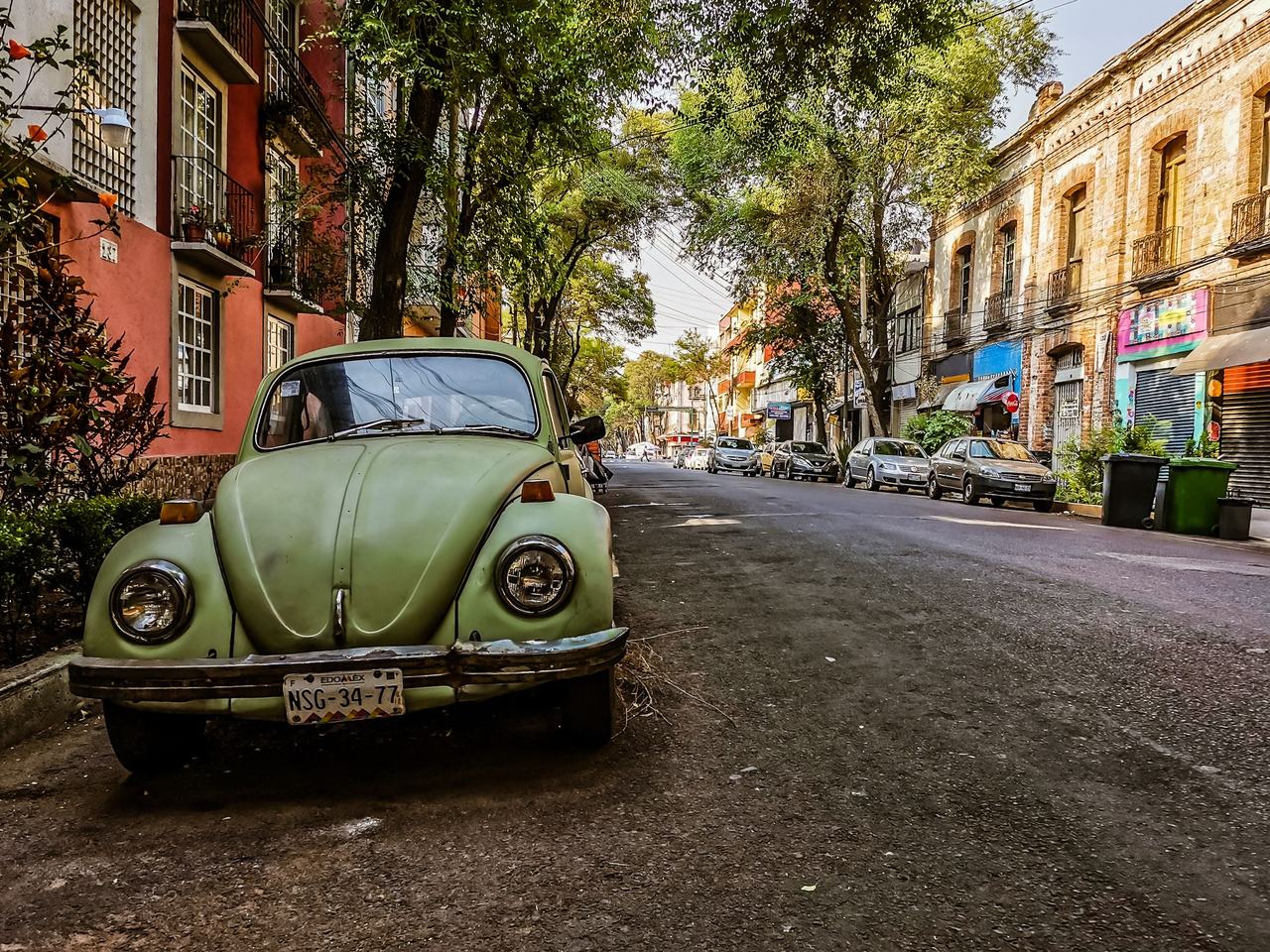
Opening photograph: A pale green Volkswagen Beetle parked on a quiet, tree-lined street in Mexico City. Photograph by Roland DRz on Pexels. Blog photo credits.