Juseyo in Korean: How to Ask for Anything Politely
Juseyo means “please give me,” and in Korean it comes after the thing you want. The course’s note puts it simply: anything plus juseyo. So 커피 주세요 is “coffee, please,” and 영수증 주세요 is “the receipt, please.” The same word also follows an action, turning it into “please do this for me”: 여기서 세워 주세요 asks a taxi driver to stop. Those two patterns, a thing plus juseyo and an action plus juseyo, cover most of the requests in the course, from the café to the taxi.
What juseyo means
English puts “please” anywhere in the sentence. Korean puts juseyo at the end, after the thing you are asking for. That makes it very forgiving: you only need the name of the thing, and juseyo does the rest. Here is the course’s own note on it:
You say
아메리카노 주세요.
amerikano juseyo.
An americano, please.
Anything + 주세요: please give me.
You will see the course translate juseyo as “please” in almost every line on this page, because that is how it lands in English. “An americano, please” is exactly the feel.
Thing plus juseyo: asking for things
At the café, at the convenience store and at the restaurant table, most of what you want is a thing. Name it and add juseyo:
You say
커피 주세요.
keopi juseyo.
Coffee, please.
You say
봉투 하나 주세요.
bongtu hana juseyo.
One bag, please.
You say
영수증 주세요.
yeongsujeung juseyo.
The receipt, please.
If you want a number, it goes between the thing and juseyo. The course notes that han jan means one cup, so a full café order follows the same order, with the description first:
You say
따뜻한 아메리카노 한 잔 주세요.
ttatteutan amerikano han jan juseyo.
One hot americano, please.
따뜻한: hot or warm. 한 잔: one cup.
At the restaurant, two of the course’s requests are the menu and water. Both use the same pattern with one small addition, which is the subject of the next section:
You say
메뉴판 좀 주세요.
menyupan jom juseyo.
Could we have the menu, please?
좀 softens a request, like please.
You say
물 좀 주세요.
mul jom juseyo.
Some water, please.
Water is often self-service: 물은 셀프예요.
To ask for more of something, the course adds deo, more, just before juseyo. At a street food stall, one more fish cake sounds like this, and the course uses the same shape for more side dishes at a restaurant, 반찬 좀 더 주세요:
You say
어묵 하나 더 주세요.
eomuk hana deo juseyo.
One more fish cake, please.
더: more.
If you do not know the word for something, point and say igeo, this, in front of juseyo. That trick has its own guide: igeo juseyo, ordering by pointing.
Adding jom: a softer request
You may have noticed jom in the menu and water lines. The course note says it softens a request, like please. It sits right before juseyo and makes the request a touch gentler. A request without it is still a normal request, as the coffee and receipt lines show; jom simply softens it.
You will also find jom in a request that needs all the softening it can get. At a market stall, the course teaches this line for asking the seller to come down a little:
You say
좀 깎아 주세요.
jom kkakka juseyo.
Could you give me a discount?
For a market stall, not a shop with price tags.
As the note says, it is for a market stall, not for a shop with price tags.
Action plus juseyo: asking someone to do something
The second pattern puts an action in front of juseyo. Now you are not asking for an object but for a favor: stop, show me, heat it up, leave it out. The course translates each of these as “please” plus the action, and that is the simplest way to understand them.
In a taxi, you ask the driver to stop, or tell him where to go:
You say
여기서 세워 주세요.
yeogiseo sewo juseyo.
Please stop here.
세우다: to stop a car.
You say
명동으로 가 주세요.
myeongdongeuro ga juseyo.
To Myeongdong, please.
Place + 으로 가 주세요 (로 after a vowel or ㄹ): please take me to that place.
At the convenience store, when the clerk offers to heat up your lunch box, this is the yes:
You say
네, 데워 주세요.
ne, dewo juseyo.
Yes, please heat it up.
In a clothes shop, you ask to see a color:
You say
흰색으로 보여 주세요.
hinsaegeuro boyeo juseyo.
Could I see the white one?
보여 주세요: please show me.
At the café, you change your drink. An extra shot is something added, and syrup is something left out:
You say
샷 추가해 주세요.
syat chugahae juseyo.
An extra shot, please.
추가: extra, added.
You say
시럽은 빼 주세요.
sireobeun ppae juseyo.
No syrup, please.
빼 주세요: please leave it out.
And when a delivery rider calls and you are not home, the course gives you this:
You say
문 앞에 놔 주세요.
mun ape nwa juseyo.
Please leave it at the door.
놔 주세요: please put it, short for 놓아 주세요. Delivery apps offer it as a request: 문 앞에 두고 가 주세요.
You do not need to take these apart to use them. Learn them whole, the way the course teaches them, and swap in the place or the color when you need to.
The juseyo you will hear from staff
Because juseyo means “please do this,” staff use it with you too. Hearing it helps you understand what you are being asked to do. When Jimin, the barista, has your order, she asks you to wait:
Jimin, the barista, says
네, 잠시만 기다려 주세요.
ne, jamsiman gidaryeo juseyo.
Sure, just a moment, please.
When you pay, she asks you to insert your card, while the taxi driver asks you to tap it:
Jimin, the barista, says
네, 카드 꽂아 주세요.
ne, kadeu kkoja juseyo.
Okay, insert your card, please.
The taxi driver says
카드 여기 대 주세요.
kadeu yeogi dae juseyo.
Tap your card here, please.
And when you get into a taxi, the driver may ask this:
The taxi driver says
안전벨트 해 주세요.
anjeonbelteu hae juseyo.
Please put your seat belt on.
In each case, the word right before juseyo tells you what to do. If you catch only juseyo, you at least know it is a request, and a quick look at what the other person is pointing at usually fills in the rest.
A day of juseyo in Seoul
To see how far the two patterns go, here is one ordinary day, using only lines from the course:
- Morning coffee: 따뜻한 아메리카노 한 잔 주세요.
- No syrup in it: 시럽은 빼 주세요.
- A bag at the convenience store: 봉투 하나 주세요.
- Heat up the lunch box: 네, 데워 주세요.
- Lunch, and the menu: 메뉴판 좀 주세요.
- Seeing a sweater in white: 흰색으로 보여 주세요.
- A taxi to Myeongdong: 명동으로 가 주세요.
- Dinner delivered while you are out: 문 앞에 놔 주세요.
Eight requests, one word doing the work in each. Once you hear juseyo as a slot that anything can go in front of, the menu stops being the hard part.
Every line on this page is a recording from Sori’s course. In the app you hear each line, say it out loud and see what it heard, which helps the end of the word come out cleanly: juseyo, not a mumble.
Every line on this page
The 20 lines above, in order, for one last listen before you go. Each one is the recording from the Sori course.
아메리카노 주세요.amerikano juseyo.An americano, please.
커피 주세요.keopi juseyo.Coffee, please.
봉투 하나 주세요.bongtu hana juseyo.One bag, please.
영수증 주세요.yeongsujeung juseyo.The receipt, please.
따뜻한 아메리카노 한 잔 주세요.ttatteutan amerikano han jan juseyo.One hot americano, please.
메뉴판 좀 주세요.menyupan jom juseyo.Could we have the menu, please?
물 좀 주세요.mul jom juseyo.Some water, please.
어묵 하나 더 주세요.eomuk hana deo juseyo.One more fish cake, please.
좀 깎아 주세요.jom kkakka juseyo.Could you give me a discount?
여기서 세워 주세요.yeogiseo sewo juseyo.Please stop here.
명동으로 가 주세요.myeongdongeuro ga juseyo.To Myeongdong, please.
네, 데워 주세요.ne, dewo juseyo.Yes, please heat it up.
흰색으로 보여 주세요.hinsaegeuro boyeo juseyo.Could I see the white one?
샷 추가해 주세요.syat chugahae juseyo.An extra shot, please.
시럽은 빼 주세요.sireobeun ppae juseyo.No syrup, please.
문 앞에 놔 주세요.mun ape nwa juseyo.Please leave it at the door.
네, 잠시만 기다려 주세요.ne, jamsiman gidaryeo juseyo.Sure, just a moment, please.
네, 카드 꽂아 주세요.ne, kadeu kkoja juseyo.Okay, insert your card, please.
카드 여기 대 주세요.kadeu yeogi dae juseyo.Tap your card here, please.
안전벨트 해 주세요.anjeonbelteu hae juseyo.Please put your seat belt on.
Common questions
What does juseyo mean in Korean?
It means “please give me,” and it comes after the thing you want: 커피 주세요, coffee please. After an action, it means “please do this,” as in 여기서 세워 주세요.
What is the difference between juseyo and jom juseyo?
Jom softens the request, like please. The course uses it in lines such as 물 좀 주세요 and 메뉴판 좀 주세요, both from its restaurant unit.
How do you say please in Korean?
Put juseyo after what you want. In the course’s requests, juseyo is the word that the English “please” translates: 영수증 주세요 is “the receipt, please,” and 메뉴판 좀 주세요 is “could we have the menu, please.”
How do I ask for no syrup or no bag in Korean?
For no syrup, say 시럽은 빼 주세요; the course notes that it means please leave it out. For no bag, the course does not use juseyo at all: 봉투는 괜찮아요 means no bag, thanks.
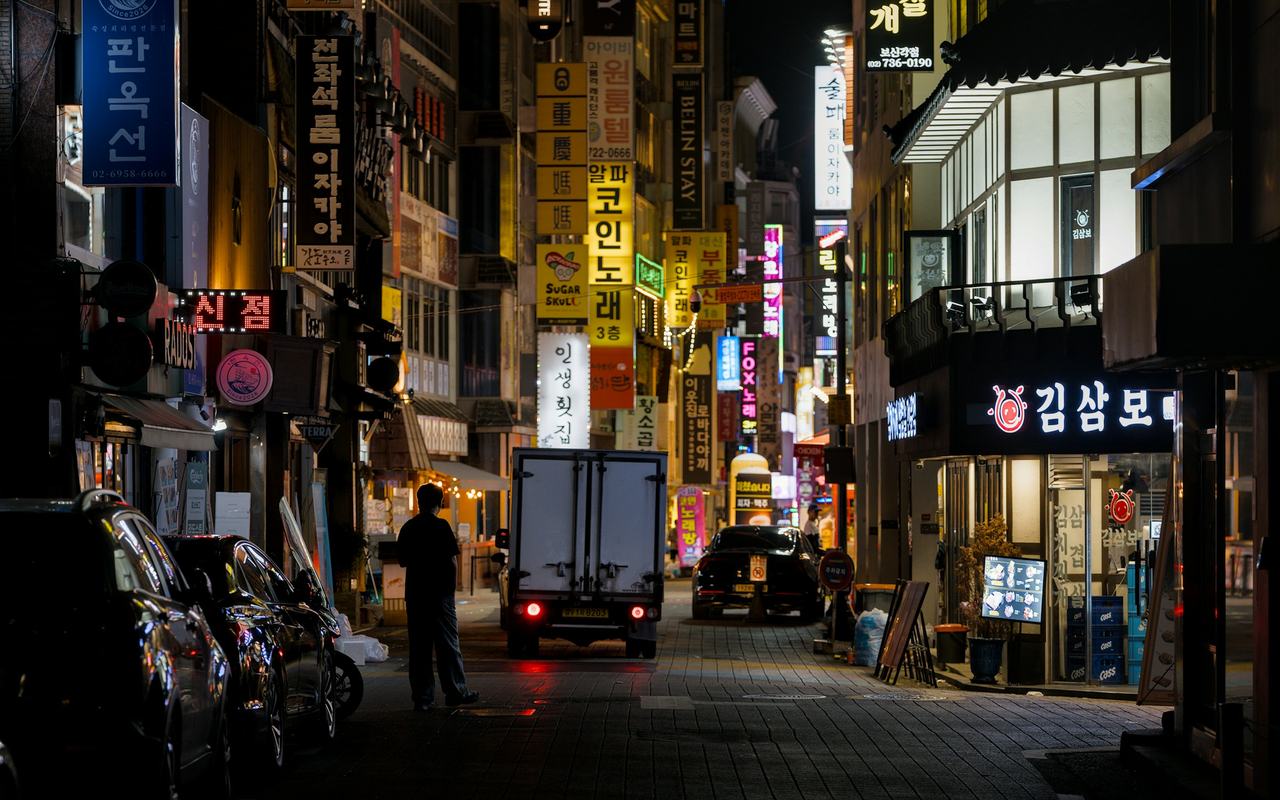
Opening photograph: A person stands in a narrow Seoul street at night under stacked signs. Photograph by Julien on Unsplash. Blog photo credits.