Dwaeyo in Korean: Asking If Something Is Possible
To ask “can I” or “does this work here” in Korean, put dwaeyo? after the thing you are asking about: 여기 카드 돼요? means “do you take cards here?” The course note explains that dwaeyo? asks whether something works or is allowed. To ask permission to try something, the course uses a longer form that ends the same way: 입어 봐도 돼요?, can I try it on? The answer you want to hear is ne, dwaeyo, yes, it works. The same word asks the question and gives the yes.
What dwaeyo asks
Dwaeyo is a short, practical word. As a question, it means something like “does it work?” or “is it okay?” Put a thing in front of it and you are asking whether that thing works here. That makes these questions easy to build on a trip: one noun you know, plus the word you have just learned, and you can ask about a card, a service or a return without any other grammar. Here is the line the course uses to teach it, with its note:
You ask
여기 카드 돼요?
yeogi kadeu dwaeyo?
Do you take cards here?
돼요? asks whether something works or is allowed: can I use a card here?
That one sentence gives you the whole pattern: yeogi, here, then the thing, kadeu, card, then dwaeyo? Swap the thing and you have a new question. The course does exactly that for a transit card top-up, an exchange, a refund and a delivery, and you will meet all of them below.
Do you take cards here?
The card question is a good first one to learn, because you can use it at almost any counter. In the course, Jimin is paying for snacks at the convenience store. The clerk, Junho, gives the total, she asks about cards, and he says yes and tells her where to put it:
Junho, the store clerk, says
칠천팔백 원입니다.
chilcheonpalbaek wonimnida.
That’s 7,800 won.
You ask
여기 카드 돼요?
yeogi kadeu dwaeyo?
Do you take cards here?
Junho, the store clerk, says
네, 돼요. 여기 꽂아 주세요.
ne, dwaeyo. yeogi kkoja juseyo.
Yes. Insert it here, please.
Listen to the start of Junho’s answer: ne, dwaeyo. That is the yes, and it repeats the word from the question. Whenever you ask a dwaeyo? question, listen for dwaeyo in the reply. If you hear it after ne, the answer is yes.
Can I top up a transit card here?
The same pattern works for a service. In the next line Jimin asks about topping up her transit card. Here the course writes the thing and dwaeyo together as one word, chungjeondwaeyo, but the pattern is the same:
You ask
교통카드 충전돼요?
gyotongkadeu chungjeondwaeyo?
Can I top up a transit card here?
Convenience stores top up T-money and other transit cards for cash only: 현금만 돼요.
Junho, the store clerk, asks
네, 현금만 돼요. 얼마 충전해 드릴까요?
ne, hyeongeumman dwaeyo. eolma chungjeonhae deurilkkayo?
Sure, cash only. How much would you like to add?
This is a useful answer to understand, because it is a yes with a condition. Hyeongeumman dwaeyo means cash only: it works, but only with cash. The course note on the question tells you to expect it, since convenience stores top up transit cards for cash only. In the role play, Junho gives the short version:
Junho, the store clerk, says
네, 현금만 돼요.
ne, hyeongeumman dwaeyo.
Yes, cash only.
For the full top-up exchange, including how much to add, see how to top up a T-money card in Korean.
Can I try it on?
Asking permission to try something uses a slightly longer form. The course’s note breaks it down: the verb for wearing, then bwado dwaeyo?, may I try? In the clothes shop, Minjun asks by the fitting room, and Daeun, the shop assistant, tells him where it is:
Minjun, a friend, asks
이거 입어 봐도 돼요?
igeo ibeo bwado dwaeyo?
Can I try this on?
Daeun, the shop assistant, says
네, 탈의실은 저쪽이에요.
ne, taruisireun jeojjogieyo.
Sure, the fitting room is over there.
Shoes need a different verb, and the course teaches it as a separate line with its own note:
You ask
이 신발 신어 봐도 돼요?
i sinbal sineo bwado dwaeyo?
Can I try these shoes on?
Shoes take 신다, not 입다.
You do not have to build these yourself. Learn the two lines whole, one for clothes and one for shoes, and add igeo, this, at the front when you are pointing at something, as Minjun does.
Exchanges, refunds and delivery
Back to the short pattern. When you buy something you are not sure about, two questions are worth asking at the counter before you pay:
You ask
이거 교환돼요?
igeo gyohwandwaeyo?
Can I exchange this?
You ask
이거 환불돼요?
igeo hwanbuldwaeyo?
Can I get a refund on this?
In the course, Seoyeon asks about an exchange after deciding to buy, and Daeun gives a yes with a condition, the same way the convenience store did:
Daeun, the shop assistant, says
네, 영수증 가지고 오시면 돼요.
ne, yeongsujeung gajigo osimyeon dwaeyo.
Yes, if you bring the receipt.
The condition is the receipt: yes, if you bring it back. Notice the dwaeyo at the end of her answer again. It is the “that works” part.
The last use is on the phone. If you call a restaurant to order food, one thing to check is whether they deliver. The course note adds a detail: on the phone, geogi, there, means the place you are calling.
You ask
거기 배달돼요?
geogi baedaldwaeyo?
Do you deliver?
On the phone, 거기 (there) is the place you are calling.
The answers you will hear
The useful thing about dwaeyo? questions is that the answers are predictable. In the course you hear three kinds:
- A plain yes: ne, dwaeyo, as Junho says about the card.
- A yes with a limit: hyeongeumman dwaeyo, cash only.
- A yes with a condition: yeongsujeung gajigo osimyeon dwaeyo, if you bring the receipt.
In each case, dwaeyo is the word that carries the yes, and what comes before it is the limit or the condition. Train your ear on that one word and you will understand far more answers than you can say.
Every line on this page is a recording from Sori’s course. In the app you hear each line, say it out loud and see what it heard, which is a good way to get the thing and the dwaeyo after it out clearly, in one breath.
Every line on this page
The 13 lines above, in order, for one last listen before you go. Each one is the recording from the Sori course.
여기 카드 돼요?yeogi kadeu dwaeyo?Do you take cards here?
칠천팔백 원입니다.chilcheonpalbaek wonimnida.That’s 7,800 won.
네, 돼요. 여기 꽂아 주세요.ne, dwaeyo. yeogi kkoja juseyo.Yes. Insert it here, please.
교통카드 충전돼요?gyotongkadeu chungjeondwaeyo?Can I top up a transit card here?
네, 현금만 돼요. 얼마 충전해 드릴까요?ne, hyeongeumman dwaeyo. eolma chungjeonhae deurilkkayo?Sure, cash only. How much would you like to add?
네, 현금만 돼요.ne, hyeongeumman dwaeyo.Yes, cash only.
이거 입어 봐도 돼요?igeo ibeo bwado dwaeyo?Can I try this on?
네, 탈의실은 저쪽이에요.ne, taruisireun jeojjogieyo.Sure, the fitting room is over there.
이 신발 신어 봐도 돼요?i sinbal sineo bwado dwaeyo?Can I try these shoes on?
이거 교환돼요?igeo gyohwandwaeyo?Can I exchange this?
이거 환불돼요?igeo hwanbuldwaeyo?Can I get a refund on this?
네, 영수증 가지고 오시면 돼요.ne, yeongsujeung gajigo osimyeon dwaeyo.Yes, if you bring the receipt.
거기 배달돼요?geogi baedaldwaeyo?Do you deliver?
Common questions
What does dwaeyo mean in Korean?
As a question, dwaeyo? asks whether something works or is allowed. The course’s example is 여기 카드 돼요?, do you take cards here? In an answer, ne, dwaeyo means yes, it works.
How do you ask “do you take cards” in Korean?
Say 여기 카드 돼요?. If the answer starts with ne, dwaeyo, cards are fine. Once cards are fine, 카드로 할게요, I’ll pay by card, is the line for the moment you hand the card over.
How do you say “can I try this on” in Korean?
For clothes, say 이거 입어 봐도 돼요?. For shoes the verb changes, and the course line is 이 신발 신어 봐도 돼요?.
What does hyeongeumman dwaeyo mean?
It means cash only. In the course, the convenience store clerk says it when asked about topping up a transit card, which the course notes is cash only.
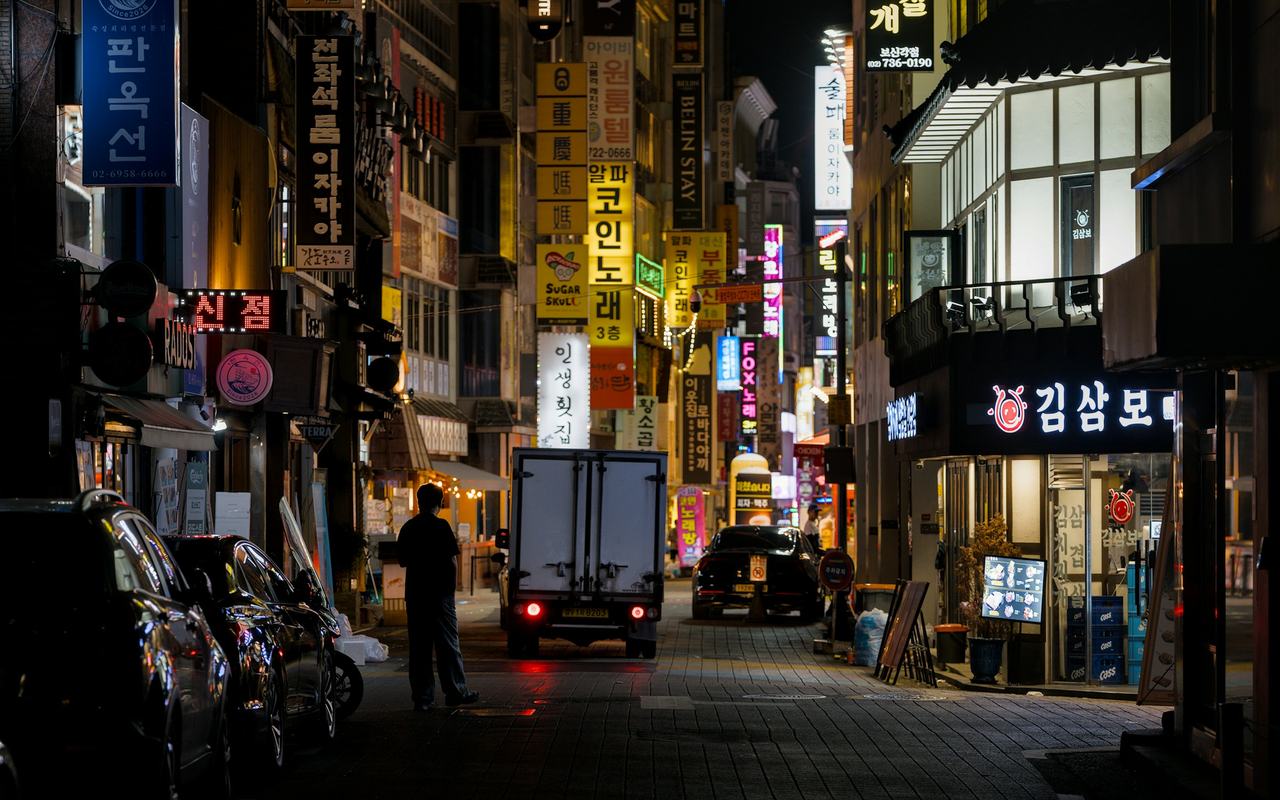
Opening photograph: A person stands in a narrow Seoul street at night under stacked signs. Photograph by Julien on Unsplash. Blog photo credits.