Thank You in Korean: Gamsahamnida or Gomawoyo
In Korean, say 감사합니다 (gamsahamnida) to anyone, and especially to strangers, anyone older and anyone who serves you. Say 고마워요 (gomawoyo) to friends and coworkers: the course calls it warm and still polite. If you are unsure, use gamsahamnida. As a visitor, that one form covers the café, the taxi, the convenience store and the pharmacy, and gomawoyo is for the people you get to know.
Gamsahamnida: the thank you that works with everyone
The course sums it up in a few words: a set phrase, the polite thank you, for anyone. You do not need to change it for the person in front of you or the situation. It is the same whether you are thanking a barista for your coffee or a stranger for directions.
You say
감사합니다.
gamsahamnida.
Thank you.
A set phrase: the polite thank you, for anyone.
Listen to how it sounds in a real exchange. At the café counter, Jimin, the barista, brings out a latte and Minjun takes it with a short ne and the thank you:
Jimin, the barista, says
여기 라테 나왔어요.
yeogi rate nawasseoyo.
Here’s your latte.
Minjun, a friend, says
네, 감사합니다.
ne, gamsahamnida.
Great, thank you.
That ne in front is worth copying. The course notes that ne means yes, and also okay or sure, so ne, gamsahamnida lands somewhere between “great” and “got it, thanks.” It is a natural way to accept anything handed to you.
The same words work in a taxi. In the course, Seoyeon pays by card, the driver tells her where to tap it, and she thanks him as she does:
The taxi driver says
네, 여기 대 주세요.
ne, yeogi dae juseyo.
Sure, tap it here.
Seoyeon, a coworker, says
감사합니다.
gamsahamnida.
Thank you.
And it works between people who know each other. In a small accident at work, a friend hands something back to Seoyeon, and she thanks him with the same polite form:
Minjun, a friend, says
여기요.
yeogiyo.
Here you go.
Seoyeon, a coworker, says
감사합니다.
gamsahamnida.
Thank you.
Gomawoyo: the warmer thanks for friends
Gomawoyo means the same thing but feels closer. Here is the course’s note on where it fits, and where it does not:
You say
고마워요.
gomawoyo.
Thanks.
Warm and still polite: for friends and coworkers. With strangers, anyone older, or anyone who serves you, 감사합니다 is the safe choice.
So it is not rude, and it is still polite. It simply belongs to people you know. The deciding question is not how grateful you are but who you are talking to: a big favor from a stranger still gets gamsahamnida, and a small one from a friend can get gomawoyo. In the course you hear it between coworkers and friends. Seoyeon uses it when you tell her the time, and Minjun uses it when a coworker asks how he is after being ill:
Seoyeon, a coworker, says
고마워요.
gomawoyo.
Thanks.
Minjun, a friend, says
많이 좋아졌어요. 고마워요.
mani joajeosseoyo. gomawoyo.
Much better, thanks.
You can add it in front of a plan, too. This is how the course has you end a meetup with someone you have just added on KakaoTalk:
You say
고마워요. 나중에 연락할게요.
gomawoyo. najunge yeollakalgeyo.
Thanks. I’ll be in touch.
On a short trip, gomawoyo is the one for a language exchange partner or a new friend who shows you around. For everyone behind a counter, stay with gamsahamnida.

The same reply, two ways: pharmacist vs friend
The clearest way to see the difference is a pair of lines the course teaches side by side. Both mean “all right, thank you,” the reply you give when someone explains something and you have understood it. One is for a pharmacist or a stranger, the other for a friend or a colleague:
You say
네, 알겠습니다. 감사합니다.
ne, algetseumnida. gamsahamnida.
All right, thank you.
You say
네, 알겠어요. 고마워요.
ne, algesseoyo. gomawoyo.
All right, thank you.
To a friend or a colleague. To a pharmacist or a stranger: 네, 알겠습니다. 감사합니다.
At the pharmacy, after the pharmacist tells you how often to take your medicine, the first line is the one to say. If a friend tells you to get plenty of rest, the second one fits. The words around the thank you shift together with it, so learning the two lines whole is easier than building them yourself.
Thank you for the meal: jal meogeotseumnida
Restaurants have their own thank you. It is not a general thanks but a set phrase about the food, and the course gives it a clear time and place:
You say
잘 먹었습니다.
jal meogeotseumnida.
Thank you for the meal.
A set phrase: said as you leave a restaurant, or to whoever paid.
In the course’s restaurant scene, Minjun says it at the counter as he asks for the bill, so the two go together naturally:
Minjun, a friend, says
잘 먹었습니다. 계산해 주세요.
jal meogeotseumnida. gyesanhae juseyo.
Thank you for the meal. The bill, please.
If a Korean friend pays for dinner, the course note tells you this is the line for them as well: it thanks them for the meal itself.
The thank-yous staff say to you
You will hear gamsahamnida more often than you say it, because staff in the course use it to close most exchanges. Recognizing it helps you know when a transaction is over and you can step away. In the course, Jimin says it when you tell her you will pay in cash:
Jimin, the barista, says
네, 감사합니다.
ne, gamsahamnida.
Okay, thank you.
Junho, the convenience store clerk, puts it in front of his goodbye:
Junho, the store clerk, says
감사합니다. 안녕히 가세요.
gamsahamnida. annyeonghi gaseyo.
Thank you. Goodbye.
And on a delivery order by phone, the chicken shop owner thanks you before promising the food soon:
The chicken shop owner says
감사합니다. 금방 갖다 드릴게요.
gamsahamnida. geumbang gatda deurilgeyo.
Thank you. We’ll bring it over soon.
The one surprise is at the market. In the role play, the grandmother at the sock stall uses the warmer form with you, her customer, together with an invitation to come back:
The market seller says
고마워요. 또 와요.
gomawoyo. tto wayo.
Thanks. Come again.
That is her choice to make as the seller. For you, as the customer, the course’s advice stands: with anyone who serves you, gamsahamnida is the safe one.
Every line on this page is a recording from Sori’s course. In the app you hear a line, say it out loud, and it shows you what it heard, which is a good way to make gamsahamnida come out smoothly, without a pause in the middle, before your first counter.
Every line on this page
The 19 lines above, in order, for one last listen before you go. Each one is the recording from the Sori course.
감사합니다.gamsahamnida.Thank you.
여기 라테 나왔어요.yeogi rate nawasseoyo.Here’s your latte.
네, 감사합니다.ne, gamsahamnida.Great, thank you.
네, 여기 대 주세요.ne, yeogi dae juseyo.Sure, tap it here.
감사합니다.gamsahamnida.Thank you.
여기요.yeogiyo.Here you go.
감사합니다.gamsahamnida.Thank you.
고마워요.gomawoyo.Thanks.
고마워요.gomawoyo.Thanks.
많이 좋아졌어요. 고마워요.mani joajeosseoyo. gomawoyo.Much better, thanks.
고마워요. 나중에 연락할게요.gomawoyo. najunge yeollakalgeyo.Thanks. I’ll be in touch.
네, 알겠습니다. 감사합니다.ne, algetseumnida. gamsahamnida.All right, thank you.
네, 알겠어요. 고마워요.ne, algesseoyo. gomawoyo.All right, thank you.
잘 먹었습니다.jal meogeotseumnida.Thank you for the meal.
잘 먹었습니다. 계산해 주세요.jal meogeotseumnida. gyesanhae juseyo.Thank you for the meal. The bill, please.
네, 감사합니다.ne, gamsahamnida.Okay, thank you.
감사합니다. 안녕히 가세요.gamsahamnida. annyeonghi gaseyo.Thank you. Goodbye.
감사합니다. 금방 갖다 드릴게요.gamsahamnida. geumbang gatda deurilgeyo.Thank you. We’ll bring it over soon.
고마워요. 또 와요.gomawoyo. tto wayo.Thanks. Come again.
Common questions
Is gomawoyo rude?
No. The course describes it as warm and still polite, for friends and coworkers. It is just less suited to strangers, anyone older or anyone who serves you, where gamsahamnida is the safe choice.
Which thank you should I use in shops and restaurants?
Use 감사합니다. It is the polite thank you for anyone, and it is what staff in the course say to you too. At the end of a meal, add 잘 먹었습니다.
Can I say gamsahamnida to a friend?
Yes. The course calls it the polite thank you for anyone, and in one scene a coworker uses it with a friend who hands something back. Gomawoyo just sounds warmer between people who know each other.
What does jal meogeotseumnida mean?
The course translates it as “thank you for the meal.” It is a set phrase said as you leave a restaurant, or to whoever paid.
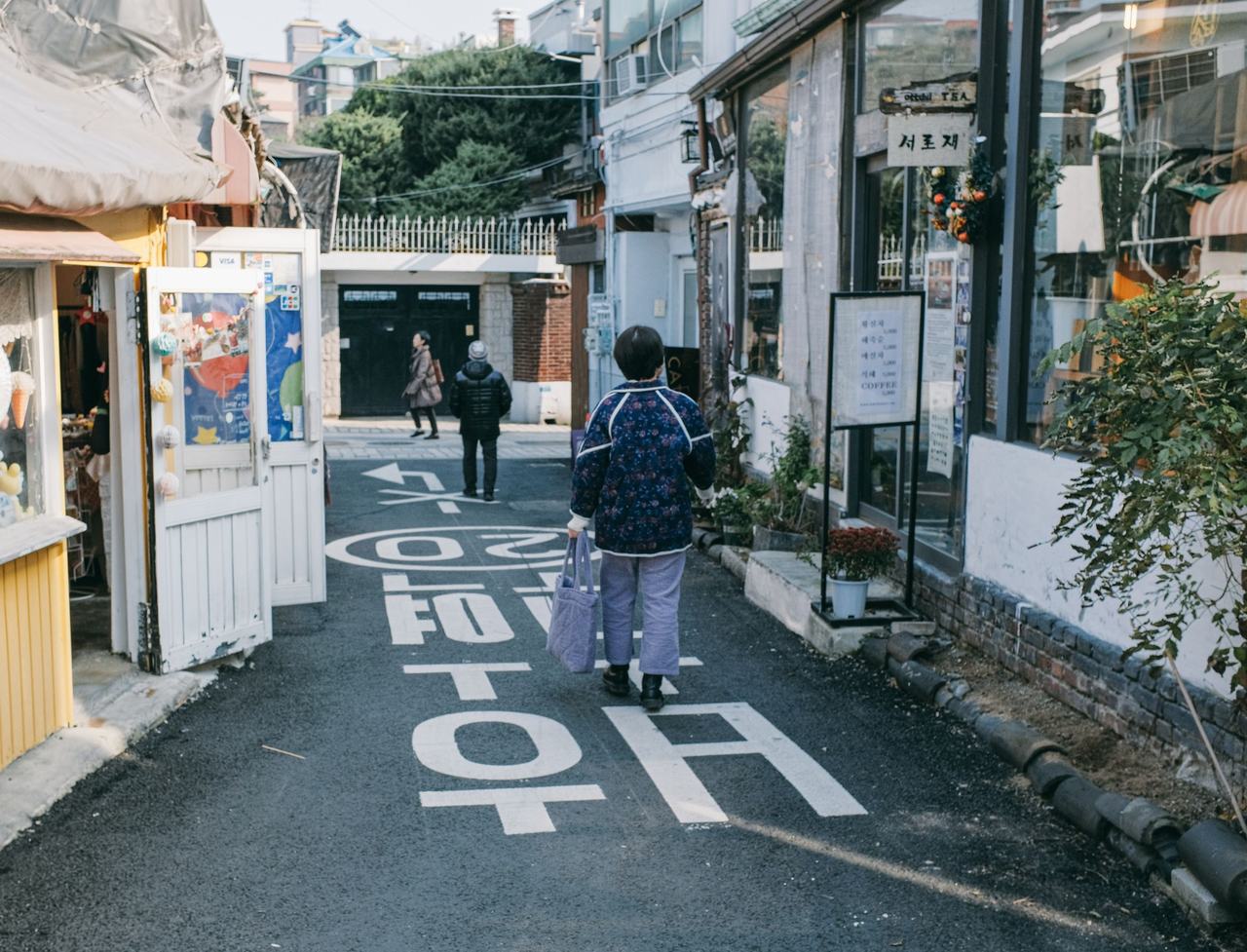
Opening photograph: A woman carrying a shopping bag walks away down a narrow lane of small shops in Seoul. Photograph by Huy Phan on Pexels. Blog photo credits.