Konglish Words You Will Hear in Seoul Shops and Cafes
A lot of the Korean you need at a Seoul counter is English said the Korean way: amerikano, kadeu (card), waipai (Wi-Fi), saijeu (size), syat (shot) and sireop (syrup). Put them in a course line like 아이스 아메리카노 한 잔 주세요 or 카드로 할게요 and you can already order and pay. The catch is that they do not sound quite like English, so the useful thing is to hear each one inside the sentence where you will meet it. Below are the English loanwords, often called Konglish, that turn up in the course, grouped by where you will hear them.
At the café counter: americano, latte, iced, size, shot, syrup
The café is where loanwords do the most work. Most of the drinks the course teaches are borrowed words. Here are two of them, with aiseu, iced, in front of the first:
You say
아이스 아메리카노 한 잔 주세요.
aiseu amerikano han jan juseyo.
One iced americano, please.
You say
카페라테 한 잔 주세요.
kaperate han jan juseyo.
One latte, please.
Menus write 카페라테 or 카페라떼; people often just say 라테.
As the note says, menus write 카페라테 or 카페라떼, and people often just say rate. Play the recording a few times so the Korean version, not the English one, is what you expect to hear back.
Then the barista asks about size, and the word is saijeu:
Jimin, the barista, asks
사이즈는 어떻게 해 드릴까요?
saijeuneun eotteoke hae deurilkkayo?
What size would you like?
You say
큰 사이즈로 주세요.
keun saijeuro juseyo.
The large size, please.
Extras use loanwords too. A syat is a shot of espresso, and sireop is syrup. One you add, the other you leave out:
You say
샷 추가해 주세요.
syat chugahae juseyo.
An extra shot, please.
추가: extra, added.
You say
시럽은 빼 주세요.
sireobeun ppae juseyo.
No syrup, please.
If you do want syrup, the flavor in the course is a loanword too. Vanilla is banilla, and it goes in front of sireop with the same word for extra:
You say
바닐라 시럽 추가해 주세요.
banilla sireop chugahae juseyo.
Add vanilla syrup, please.
Notice that the words around the loanwords stay Korean. Chugahae juseyo, please add, and ppae juseyo, please leave it out, are the parts you have to learn; the shot and the syrup you already know.
And with your drink, cookies are kuki:
You say
쿠키 두 개 주세요.
kuki du gae juseyo.
Two cookies, please.
Paying and getting online: card and Wi-Fi
Two of the most useful words on a trip are borrowed. Kadeu is card, and you hear it all through the course, from the café to the taxi. The line for paying with one is short:
You say
카드로 할게요.
kadeuro halgeyo.
I’ll pay by card.
Waipai is Wi-Fi. In the course, Minjun asks Jimin, the barista, for the password after he pays:
You ask
와이파이 비밀번호가 뭐예요?
waipai bimilbeonhoga mwoyeyo?
What’s the Wi-Fi password?
Jimin, the barista, says
영수증에 나와 있어요.
yeongsujeunge nawa isseoyo.
It’s printed on the receipt.
Her answer is that it is printed on the receipt, so it is worth keeping the receipt if you want to get online.
At the convenience store: one plus one
It looks like a math problem on a label, but the course explains it: won here is the English word one. Labels show 1+1, which means buy one, get one free, and 2+1 is 투 플러스 원. In the course, Junho, the clerk, tells you about the deal at the register:
Junho, the store clerk, says
이거 원 플러스 원이에요.
igeo won peulleoseu wonieyo.
This one’s buy one, get one free.
Note that this won is not the Korean currency, even though it is spelled and said the same way. Context tells you which one is meant: a price comes with a number in front, while won peulleoseu won is a deal.
At the restaurant: self-service water
At a restaurant, you may ask for water and be told it is selpeu, from the English word self. The course note on water says it is often self-service, and this is the line you hear:
The restaurant owner says
물은 셀프예요. 저기 정수기에 있어요.
mureun selpeuyeyo. jeogi jeongsugie isseoyo.
Water’s self-service. It’s at the water dispenser over there.
The water is at the dispenser, and you help yourself. Once you know selpeu, a sign or a quick answer from the owner makes sense right away.
Fried chicken, QR codes and concerts
A few more loanwords come up outside counters. Ordering fried chicken for delivery uses huraideu, and the course note has a detail on its spelling:
You say
후라이드 한 마리 주세요.
huraideu han mari juseyo.
One fried chicken, please.
마리: the counter for animals, and for whole chickens. 후라이드 is plain fried; 양념 comes in a sweet, spicy sauce. Menus write 후라이드; the dictionary spelling is 프라이드.
So the English word has a narrower meaning here: on a chicken menu, huraideu is the plain fried kind, as opposed to yangnyeom, in a sweet, spicy sauce. A separate course line, 반반 한 마리 주세요, has banban, which its note calls half plain fried, half seasoned, the classic order. Even the address you give for the delivery can contain a loanword: the course’s example building is hangangapateu, Hangang Apartments.
Making friends uses kyual kodeu, QR code. In the course, Jimin asks to see Tom’s so she can add him on KakaoTalk:
Jimin, the barista, says
네, 해요. 큐알 코드 보여 주세요. 제가 친구 추가할게요.
ne, haeyo. kyual kodeu boyeo juseyo. jega chingu chugahalgeyo.
Yes. Show me your QR code, and I’ll add you as a friend.
And a night out might need konseoteu, concert:
You ask
콘서트 몇 시에 시작해요?
konseoteu myeot sie sijakaeyo?
What time does the concert start?
How English words sound in Korean
The course’s romanization shows the main thing to listen for. Several of these words end in a short vowel that the English word does not have: size is saijeu, concert is konseoteu, and the seat belt the taxi driver asks you to wear is anjeonbelteu. That extra sound is why some loanwords can be hard to catch at first, even though you know the English word.
A few more patterns are visible in the course’s spellings. Fried chicken is written huraideu on menus, and latte has two spellings on menus, as the notes above say. You do not need to learn these as rules. Play each line a few times and let your ear adjust to how the familiar word sounds in a Korean sentence.
Every line on this page is a recording from Sori’s course. In the app you hear each line, say it out loud and see what it heard. That makes it easy to practice saying saijeu and kadeu the Korean way, which is the version the person at the counter is listening for.
Every line on this page
The 16 lines above, in order, for one last listen before you go. Each one is the recording from the Sori course.
아이스 아메리카노 한 잔 주세요.aiseu amerikano han jan juseyo.One iced americano, please.
카페라테 한 잔 주세요.kaperate han jan juseyo.One latte, please.
사이즈는 어떻게 해 드릴까요?saijeuneun eotteoke hae deurilkkayo?What size would you like?
큰 사이즈로 주세요.keun saijeuro juseyo.The large size, please.
샷 추가해 주세요.syat chugahae juseyo.An extra shot, please.
시럽은 빼 주세요.sireobeun ppae juseyo.No syrup, please.
바닐라 시럽 추가해 주세요.banilla sireop chugahae juseyo.Add vanilla syrup, please.
쿠키 두 개 주세요.kuki du gae juseyo.Two cookies, please.
카드로 할게요.kadeuro halgeyo.I’ll pay by card.
와이파이 비밀번호가 뭐예요?waipai bimilbeonhoga mwoyeyo?What’s the Wi-Fi password?
영수증에 나와 있어요.yeongsujeunge nawa isseoyo.It’s printed on the receipt.
이거 원 플러스 원이에요.igeo won peulleoseu wonieyo.This one’s buy one, get one free.
물은 셀프예요. 저기 정수기에 있어요.mureun selpeuyeyo. jeogi jeongsugie isseoyo.Water’s self-service. It’s at the water dispenser over there.
후라이드 한 마리 주세요.huraideu han mari juseyo.One fried chicken, please.
네, 해요. 큐알 코드 보여 주세요. 제가 친구 추가할게요.ne, haeyo. kyual kodeu boyeo juseyo. jega chingu chugahalgeyo.Yes. Show me your QR code, and I’ll add you as a friend.
콘서트 몇 시에 시작해요?konseoteu myeot sie sijakaeyo?What time does the concert start?
Common questions
What is Konglish?
It is the informal name for English-based words used in Korean. The course has many of them at everyday counters, from amerikano and kadeu to won peulleoseu won, the 1+1 deal.
What does 1+1 mean in a Korean store?
It means buy one, get one free. The course explains that won here is the English word one, and that 2+1 is 투 플러스 원.
How do you ask for the Wi-Fi password in Korean?
Ask 와이파이 비밀번호가 뭐예요?. In the course, the barista answers that it is printed on the receipt.
What does selpeu mean at a Korean restaurant?
It comes from the English word self and means self-service. The course line 물은 셀프예요. 저기 정수기에 있어요 tells you water is self-service and where the dispenser is.
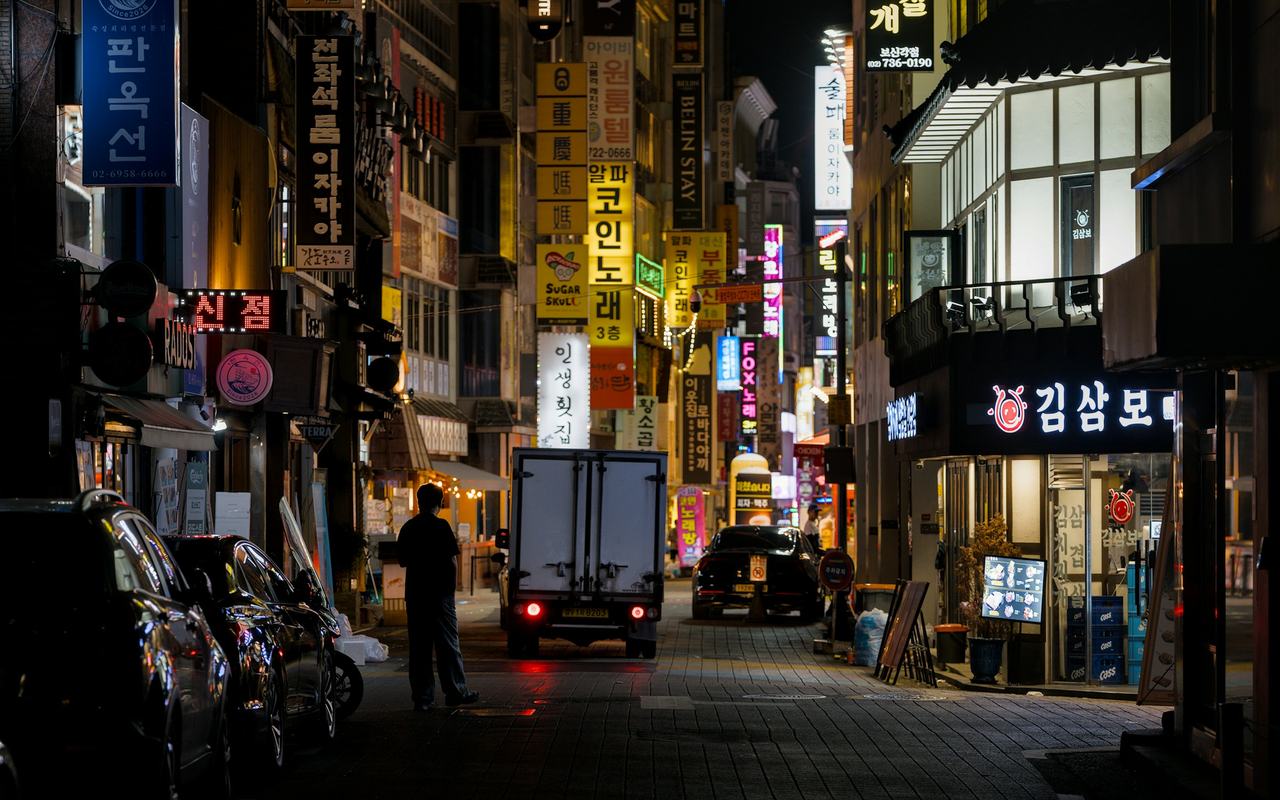
Opening photograph: A person stands in a narrow Seoul street at night under stacked signs. Photograph by Julien on Unsplash. Blog photo credits.